








 Shop the gift



Best headless funnel builder for Shopify brands: 8 compared
The best headless funnel builder for Shopify brands depends on who builds it, where checkout runs and what you pay for. Hydrogen fits developers, and PageFly and Instant keep pages in the theme. Replo, ConvertFlow, Funnelish and GemBoss host pages outside it, from $29 a month.
Quick answer
- Developers: Shopify Hydrogen, a free library with free Oxygen hosting, or Builder.io (free plan; Code Pro $30 per user a month).
- One page inside your theme: PageFly (free plan, A/B tests from $39 a month) or Instant (from $39).
- An agent that builds and hosts a page per ad: Replo, from $119 a month.
- Quizzes, popups and landing pages on any site: ConvertFlow, from $29 a month.
- A tested path per ad angle on Shopify checkout: GemBoss, from $49. Your own checkout: Funnelish, from $49.
We read every price on the vendor's own pricing page on October 26, 2026, and noted the billing basis and what each price meters. Two roundups in Google's top 10 for this question list Replo's entry plan at $99 and $119, and both match Replo's page. Each tool sits in one of four places, set by where its pages live and who builds them.
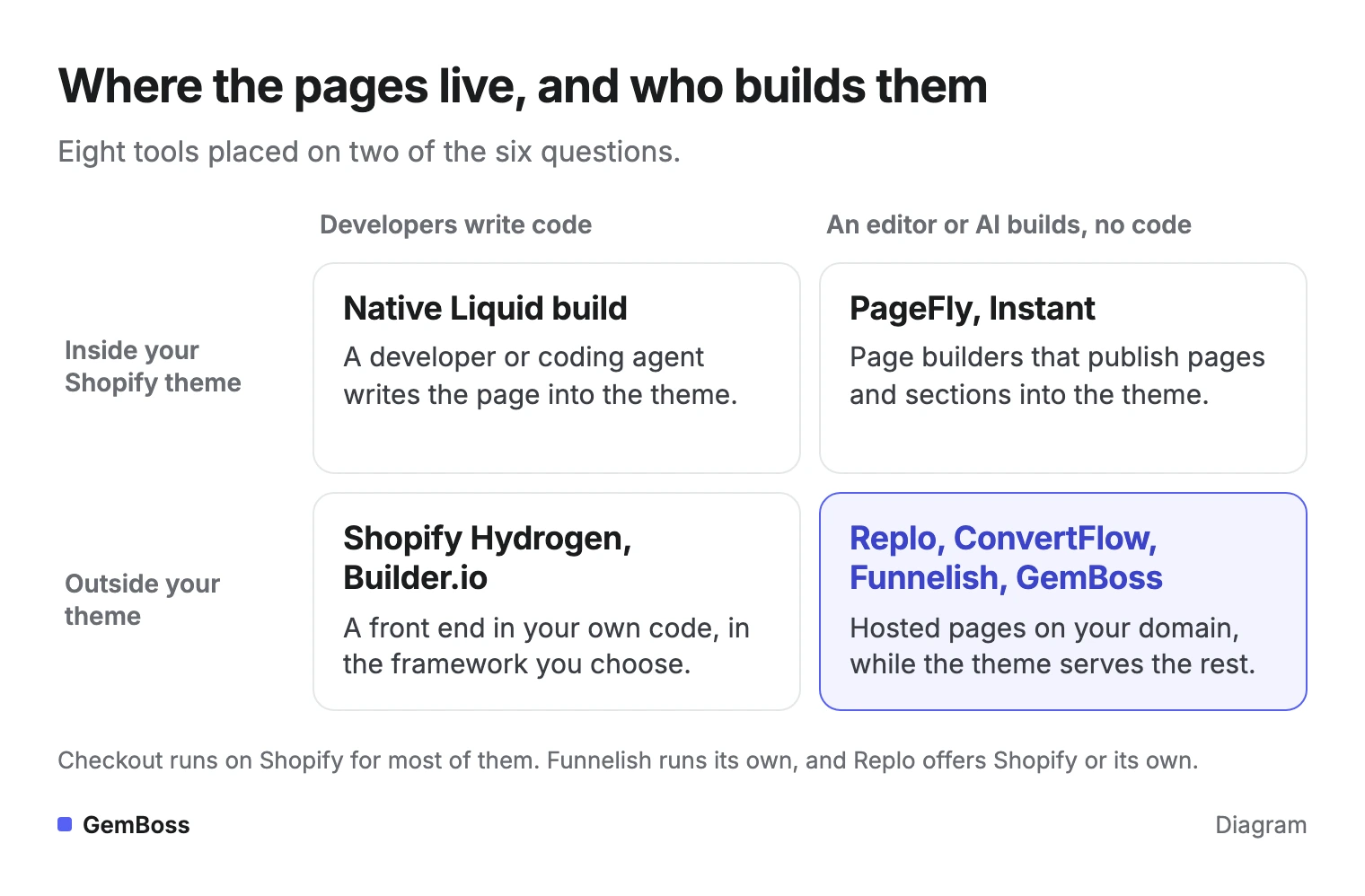
What is the best headless funnel builder for Shopify brands?
The best headless funnel builder for Shopify brands is the tool whose answers to six questions fit your team and your checkout. These are the six, with each tool's answers taken from its own pages on October 26, 2026:
- Where the pages live: inside your Liquid theme, in your own code, or on pages a vendor hosts on your domain.
- Where checkout runs: Shopify's checkout, or one the tool runs itself.
- How much of the path it builds: one page, or every step from the pre-sell page to after checkout. A pre-sell page is the article-style page an ad leads to.
- How a test is read: the metric, the statistics, and who promotes the winner.
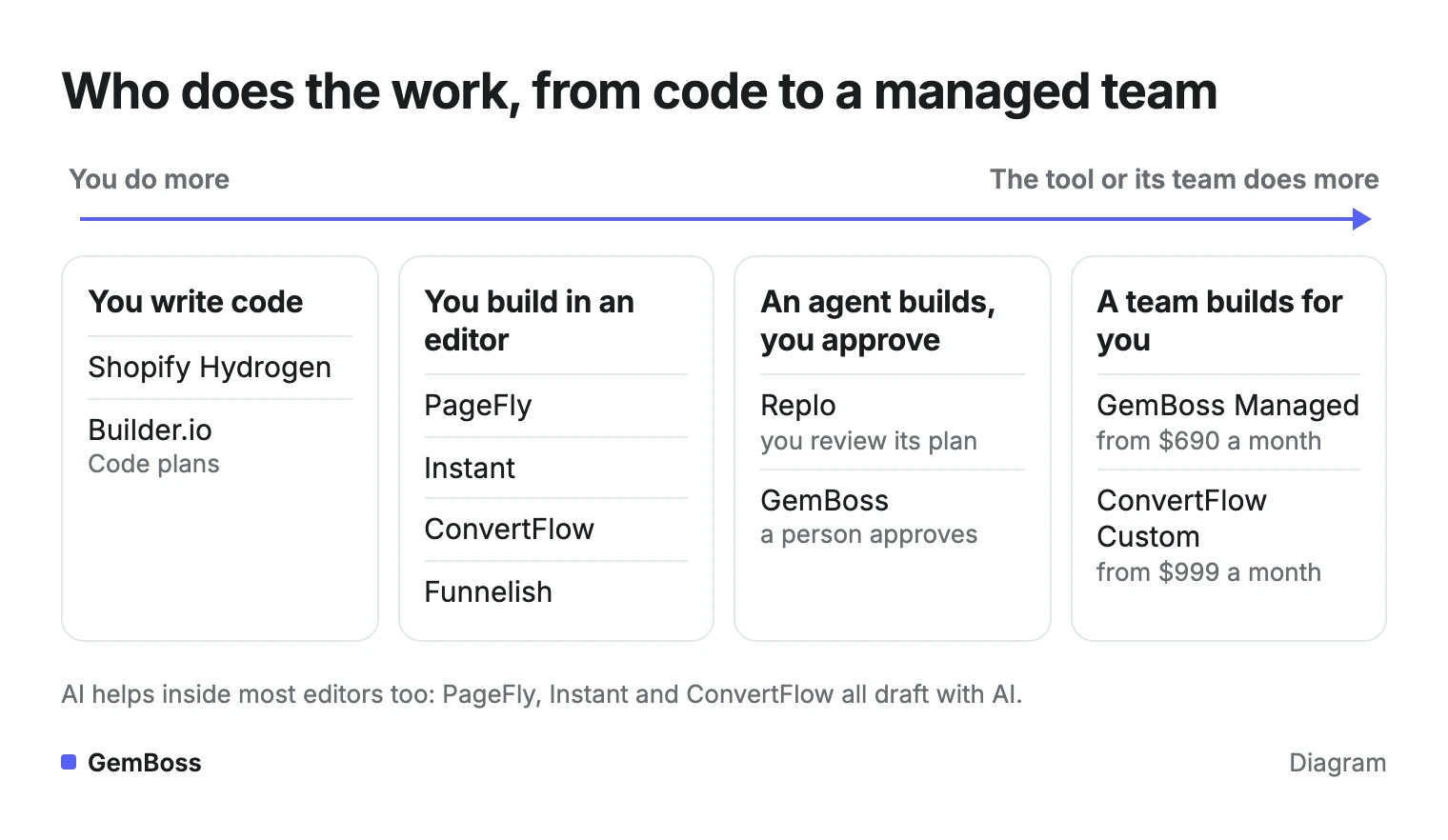
- Who does the work: developers, marketers in an editor, an agent you approve, or a managed team.
- What the price meters: traffic, pages, seats or nothing.
| Tool | Where pages live | Where checkout runs | How much of the path | Best for |
|---|---|---|---|---|
| Shopify Hydrogen | Your own code, in any JavaScript framework | Shopify Checkout | Whatever you code | Teams with developers |
| Builder.io | Your codebase (Code) or its headless CMS (Content) | Your code decides | Any page your stack renders | Engineering-led teams |
| PageFly | Inside your Shopify theme | Shopify checkout | Single pages and sections | Pages in the theme on a budget |
| Instant | Inside your theme, as pages and sections | Shopify checkout | Pages, sections, cart drawer | Design teams working in Figma |
| Replo | Hosted by Replo on your domain | Shopify or Replo checkout | Landing, advertorial and upsell pages | An agent that builds per ad |
| ConvertFlow | Your domain, Shopify pages or any site | Adds to your Shopify cart | Landing pages, quizzes, popups, upsells | Quizzes and popups site-wide |
| Funnelish | Funnelish pages on your domain | Its own checkout, orders synced to Shopify | Pages, checkout, upsells, downsells | Owning checkout and gateways |
| GemBoss | Its own pages; your theme serves the rest | Shopify checkout, untouched | Pre-sell page to post-purchase, per angle | A tested path per ad angle |
Follow the checkout column to see who takes the payment.
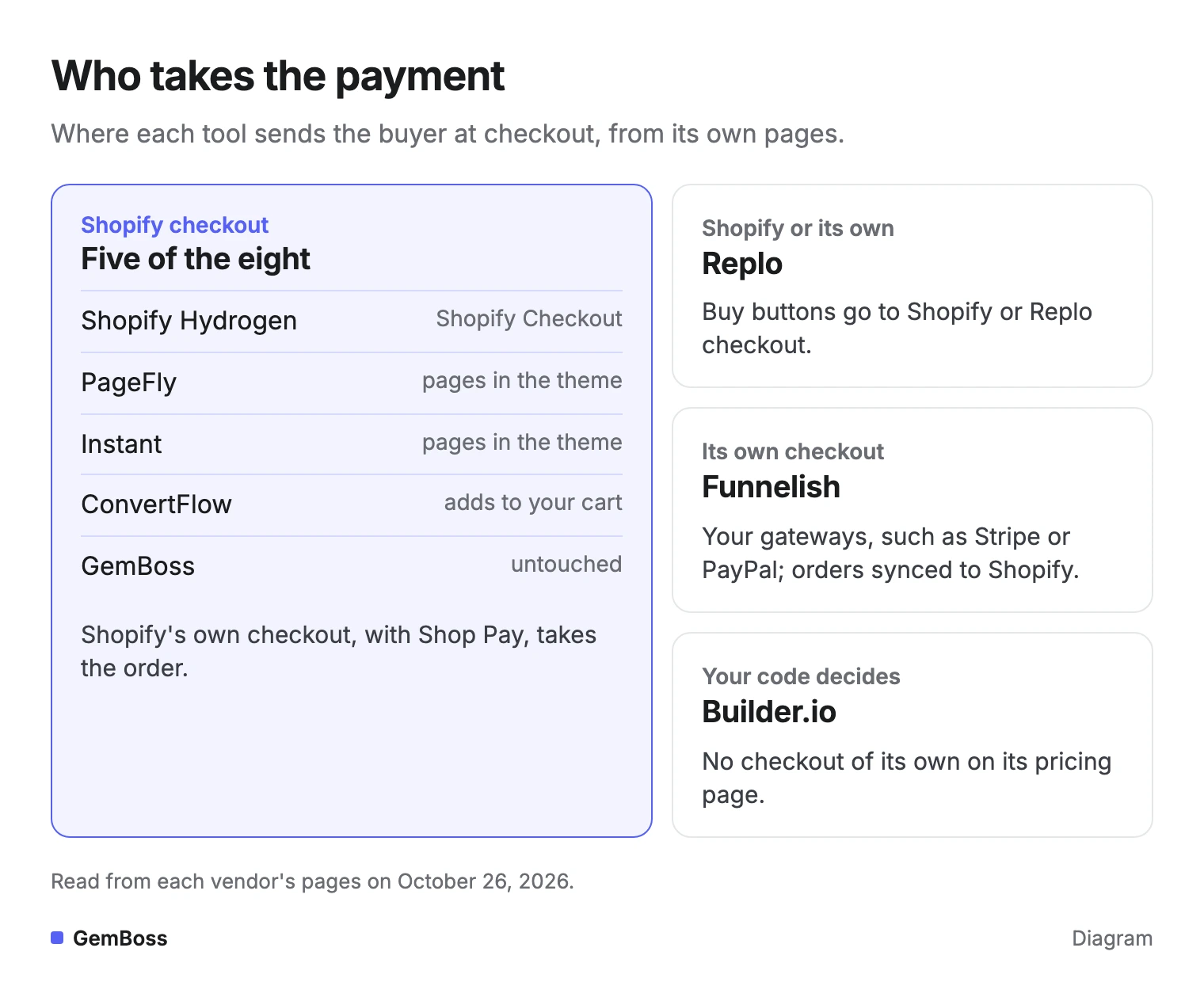
The last three questions follow, in US dollars a month, with yearly-billed rates in brackets where the vendor shows them.
| Tool | How a test is read | Who does the work | Entry price a month | What the price meters |
|---|---|---|---|---|
| Shopify Hydrogen | No test tool in its feature list | Developers or coding agents | Free library; Oxygen hosting free | Nothing; you pay developers |
| Builder.io | A/B tests listed under Content (Visual CMS) | Engineers, then marketers on top | Free (60 credits); Code Pro $30 per user ($24); Content is Enterprise only | Seats and agent credits |
| PageFly | You pick the metric; Bayesian; you publish the winner | Marketers in an editor, or AI from a prompt | Free (1 page); Builder from $24; A/B tests from $39 | Published page slots, AI credits |
| Instant | Tracks revenue per visitor among other metrics | Designers and marketers | Free (1 page); Starter $39 ($31); A/B tests from $99 | Sections, templates, AI credits, test sessions |
| Replo | Revenue and conversion tracking; test method not stated | Replo's agent; you review its plan | Free (1,000 credits once); Starter $119 ($99) | Credits and visitor sessions |
| ConvertFlow | Revenue per variant; split tests from $299 | Marketers with an AI agent; managed from $999 | Personal $29 ($25) | Monthly funnel views |
| Funnelish | Native A/B tests of headlines, pricing and layouts; method not stated | Marketers in a drag-and-drop editor | Basic $49 ($41) | Visitors and funnels |
| GemBoss | Revenue per session to the order; a person promotes | AI drafts, a person approves; Managed from $690 | Starter $49 (20% off billed yearly) | Funnel sessions |
All but a standalone Funnelish store also need a Shopify plan, which these prices leave out.
When to pick each tool, and when to pick another
Shopify Hydrogen
Hydrogen 2026-10 is a framework-agnostic JavaScript library that adds Shopify's cart, variants, buyer-currency prices, Shop Pay and customer login to your app. It costs nothing, Oxygen hosting is still free, and older Hydrogen storefronts keep working. Pick it when you have developers and a JavaScript site; pick a hosted builder when nobody will own the code.
Builder.io
Builder.io pairs a visual editor with your Git repositories (Code) or serves content through its headless CMS (Content). Code's Pro plan costs $30 per user a month with 500 agent credits, while Content, where A/B testing sits, showed only an Enterprise plan. Pick it when engineers own a design system; without a codebase, pick a hosted builder.
PageFly
PageFly builds pages and sections inside your Shopify theme. The free plan publishes one page or section, Builder starts at $24 for 5 slots, and A/B tests start on Optimize at $39. Pick it for single pages in the theme on a small budget, and a funnel tool when each ad needs several pages.
Instant
Instant publishes landing pages, theme sections and product templates into your theme, with a Figma plugin and custom Liquid code. Starter costs $39 a month for unlimited landing pages and 10 theme sections, and A/B test sessions start on Pro. Pick it when designers work in Figma, and something else for pages outside the theme.
Here is who does the work in each of the eight tools.
Replo
Replo's agent researches, builds and hosts sites on your domain, sending buyers to Shopify or Replo checkout. Starter costs $119 a month billed monthly, with 10,000 credits and 100,000 visitor sessions. Pick it to turn each ad into a hosted page, though the pages we read don't say how it calls a test winner.
ConvertFlow
ConvertFlow builds landing pages, quizzes, popups and forms, and publishes them to your domain, Shopify pages or any other site. Personal costs $29 a month for 10,000 funnel views, and funnel A/B split-testing starts on Pro at $299. Pick it for quizzes and lead capture across a site; for cheap page split tests alone, PageFly costs less.
Funnelish
Funnelish runs funnels with its own checkout, order bumps, upsells and payment gateways, and syncs orders back to Shopify. Basic costs $49 a month for up to 20,000 visitors and 20 funnels. Pick it to own the checkout or sell without a Shopify storefront, and another tool when Shopify's checkout should take every order.
GemBoss
GemBoss writes ad angles and builds the path each one needs, from the pre-sell page to the step after checkout, on its own pages. Starter costs $49 a month for 10,000 funnel sessions, 3 funnels live and 2 A/B tests at once. Pick it for a tested path per ad angle, and something else for one page in your theme, your own checkout or ad launching.
Should funnel pages live inside the Shopify theme or outside it, and where does checkout run?
Funnel pages belong inside the theme when you test one page at a time, and outside it when each ad needs several pages. Either way, checkout can stay on Shopify.
Inside the theme, PageFly, Instant and GemPages (GemPages is our sister product) publish into your Liquid theme, so setup is simple. The pages depend on what the app adds, and PageFly's FAQ notes that removing all its data leaves them blank. The fourth corner of the map is a native build, written into the theme by a developer or a coding agent.
Moving funnel pages out of the theme is a smaller change than moving the whole store.
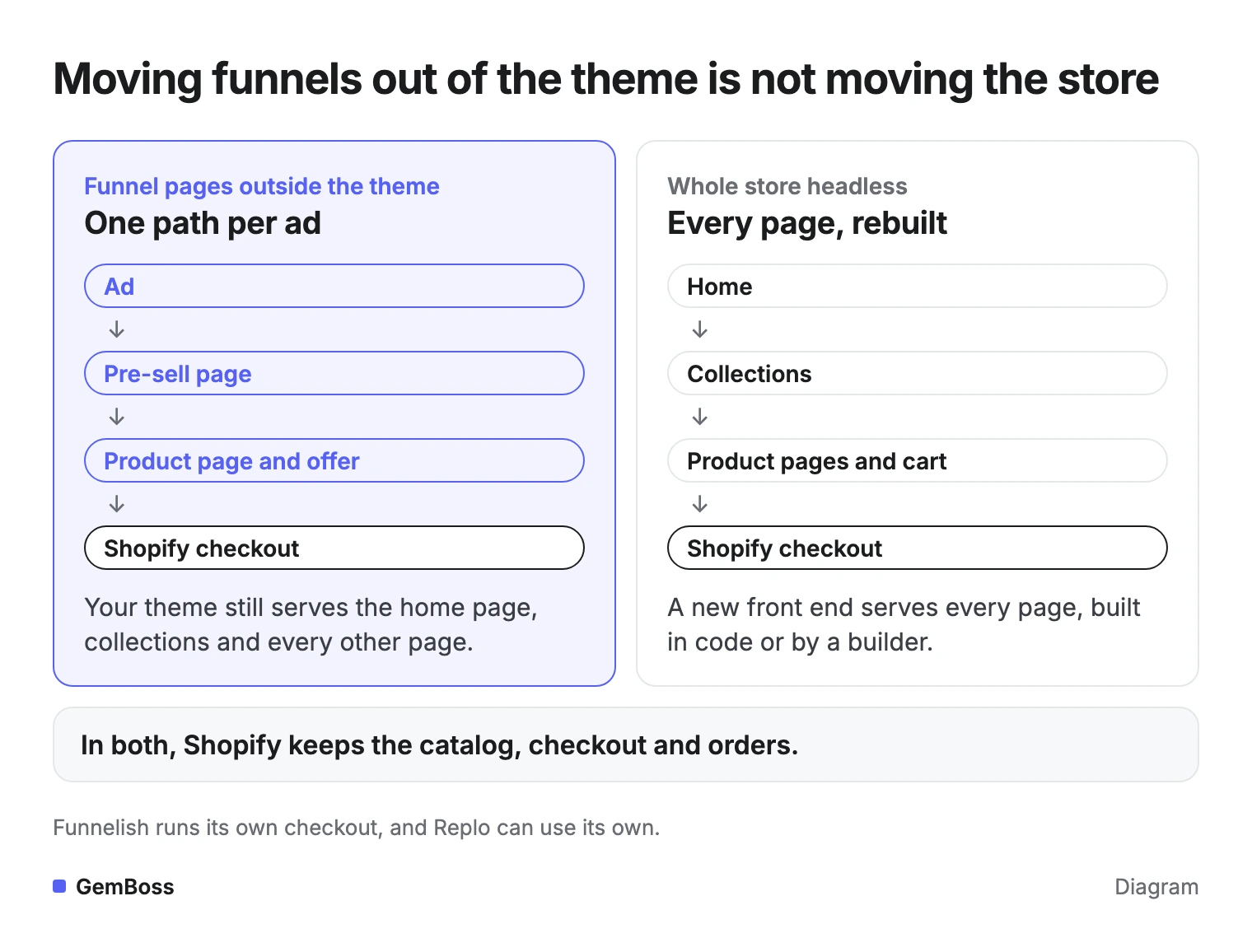
Outside the theme, the vendor serves the pages under your domain, so a new angle never touches the theme. ConvertFlow's Shopify landing page builder promises no theme edits, and Replo hosts whole sites on your domain. Those pages need their own tracking: ConvertFlow lists a Meta pixel and CAPI integration, and Funnelish a Facebook events tracking app.
Checkout is the other half of the question.
Shopify says on its homepage that its checkout with Shop Pay "converts up to 50% higher than guest checkout," citing an April 2023 study. Funnelish swaps that for gateways you connect, such as Stripe, PayPal or Airwallex.
Do landing page builders slow pages down compared with pages built natively in Shopify?
Some builder pages load slower than native ones, and only a test of the same page built both ways answers it for your store. Oliver Kenyon, who runs landing page tests for clients, posted one result on X. A native Liquid rebuild beat the builder version by 9.9% in conversion rate and 20.9% in revenue per visitor (post).
He still sees a place for builders: "They're incredible for speed, testing, and iteration. But once you've found a winner, move it into Shopify natively."
His test kept the copy, images, structure and offer the same, which is the design to copy.
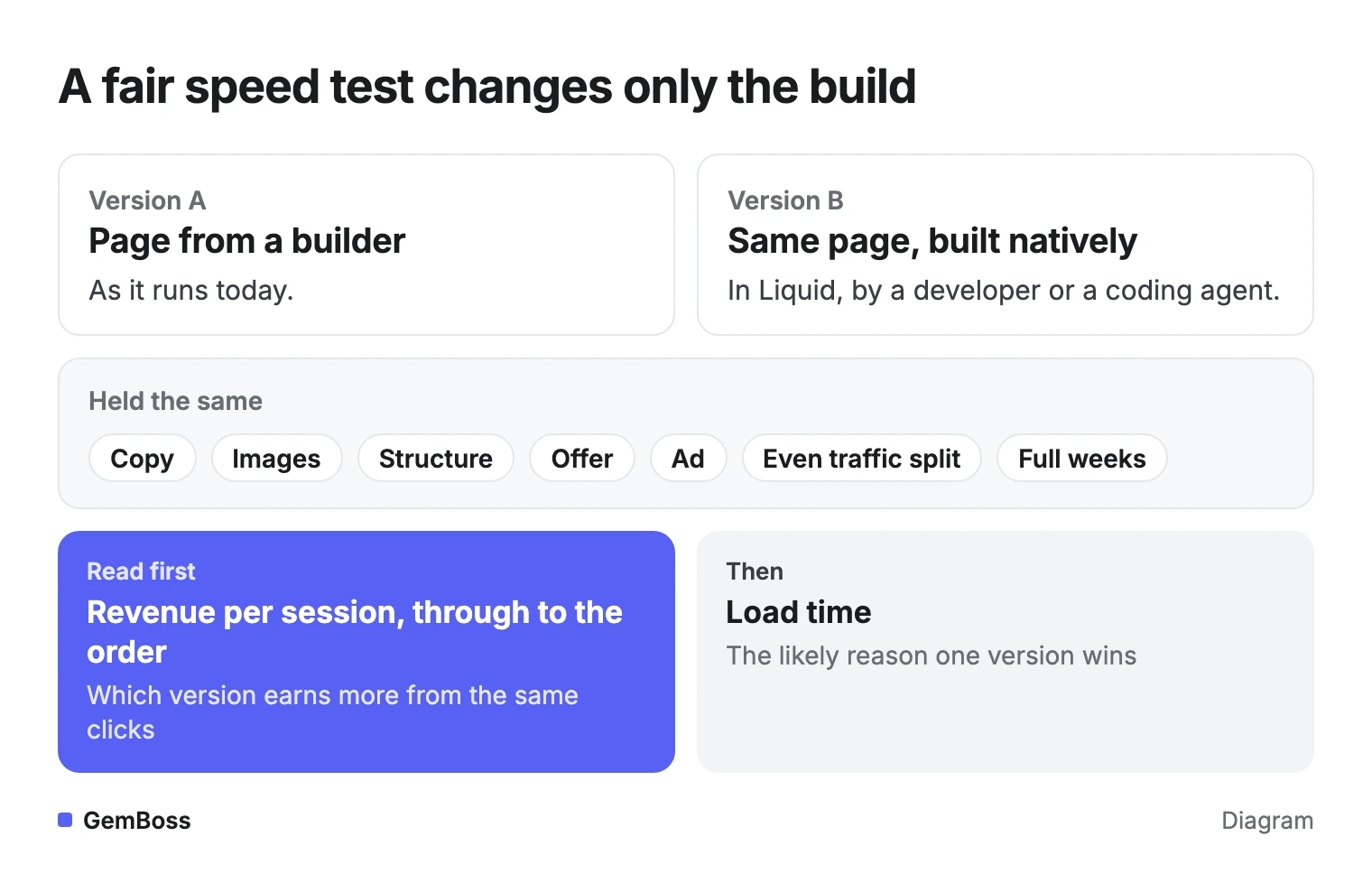
Ash, a seller on X, suggested having a coding agent rebuild builder-hosted landers natively in Shopify. He wrote that it "Increased our page load times by 5x" (post), and that hosting outside Shopify could probably improve it further.
PageFly's FAQ gives the vendor view. It says its pages load lean, with lazy loading and modular rendering keeping the impact small, and that images are usually the heaviest part.
Both results are one account each, so test on your own traffic.
Is headless Shopify worth it?
Headless Shopify is worth it when your theme blocks something specific and you have people to look after a separate front end. Running funnels outside the theme does not require moving the whole store.
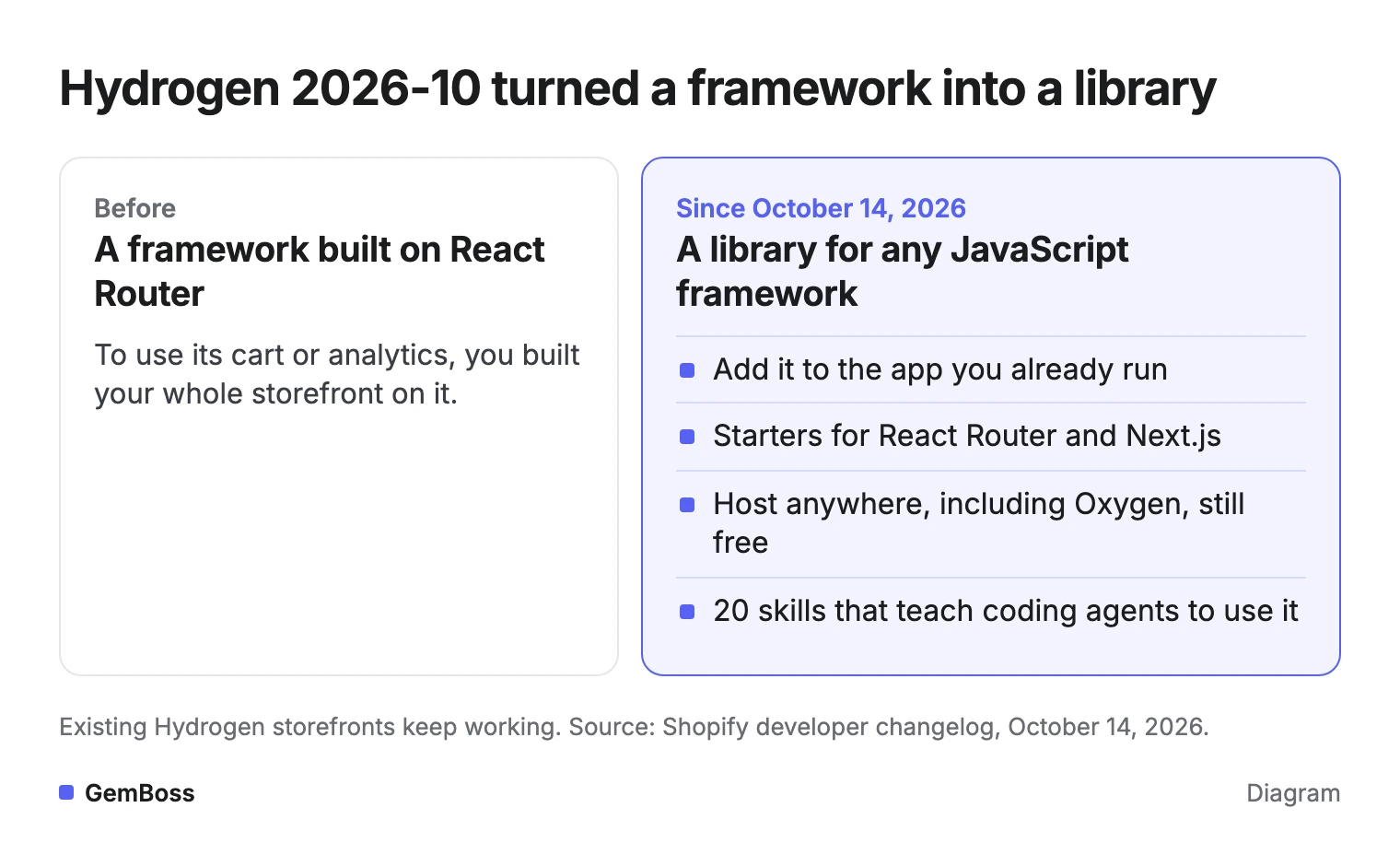
The cost of trying fell on October 14, 2026. Shopify made Hydrogen a library that works with any JavaScript framework, with React Router and Next.js starters, and said Oxygen hosting remains free. Shopify pitches it as a way to add commerce to your stack without replatforming.
Here is what changed in that release.
Practitioners still split.
ZAGO Agency, a Shopify Premier Partner, wrote on LinkedIn that framework support is a better reason than wanting a more premium site. It added: "For a theme store whose merchandising team depends on fast independent edits, it is usually a weaker case." It also says it would want evidence before approving a rebuild.
Ben Paine went further on X: "Im not sure headless shopify is the way to go anymore." For Graphite TFA, he wrote, an exceptional theme was the move, with an easier developer experience and one CMS. If that sounds like your store, read when a Liquid theme is the smarter call.
What is a headless store builder, and who needs one?
A headless store builder makes the storefront outside Shopify's Liquid theme, while Shopify keeps the catalog, cart and checkout. Brands that want home, collection and product pages rebuilt and tested need one. Brands that only need ad funnels can keep their theme.
Two routes exist. Developers build the storefront on Hydrogen or their own stack, and teams without them use a builder that serves it for them.
For the longer answer, see what a headless store builder is and who needs one.
How much does Shopify headless cost?
Headless Shopify costs nothing in software on Hydrogen and Oxygen, so the main cost is the developers who build and maintain the front end. Free hosting removes the hosting bill, not the build. Tools that host funnel pages outside the theme start at $29 to $119 a month, billed monthly, on October 26, 2026.
Billing basis moves the number. TxtCart's roundup lists Replo's Starter at $99 a month and Dash Checkout's lists $119. Both are right: Replo charges $99 a month billed annually and $119 month to month.
Replo's pricing page opens on the yearly rate, so $99 is the first Starter price a visitor sees.
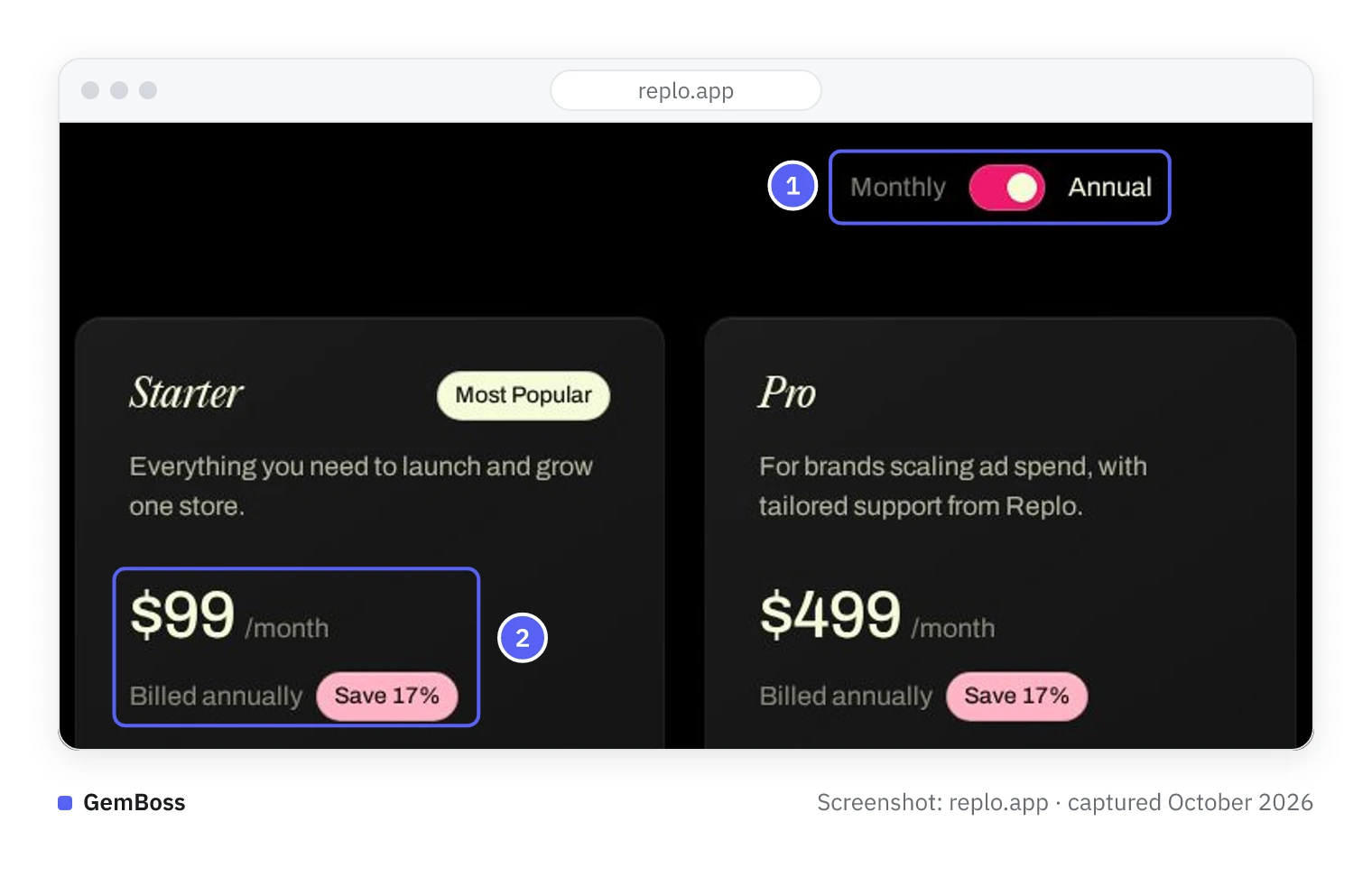
- The billing toggle, set to Annual when the page opens.
- Starter at $99 a month, billed annually. Set the toggle to Monthly and the same plan reads $119.
Most tools in the list show both prices on their pricing pages; here are four entry plans.
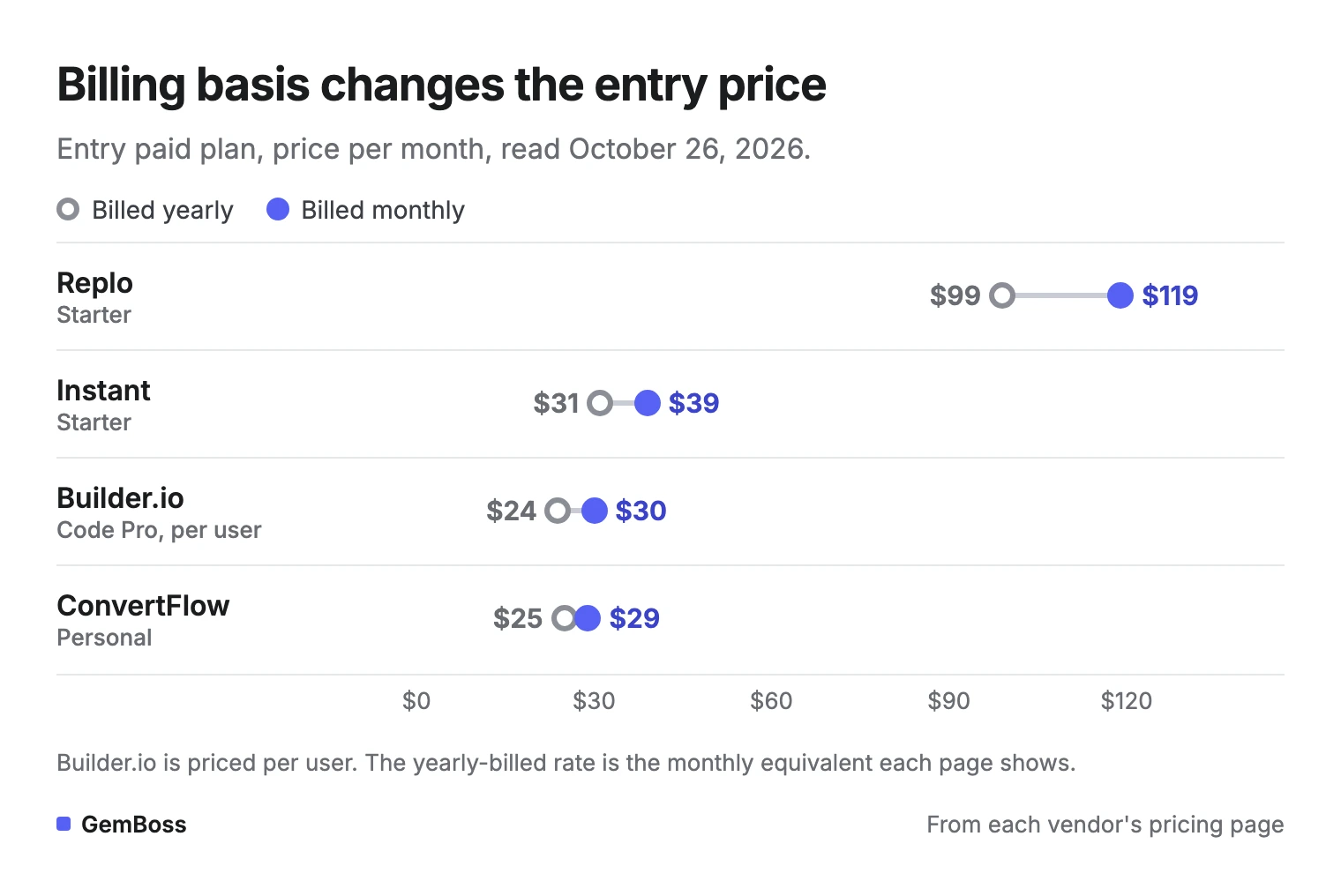
The meter matters as much as the entry price once ad spend grows. ConvertFlow, for example, bills only visitors who see a campaign and raises your traffic limit automatically when you reach it. Read each plan's definition before you compare session counts.
Grouped by what they count, the entry prices look like this.
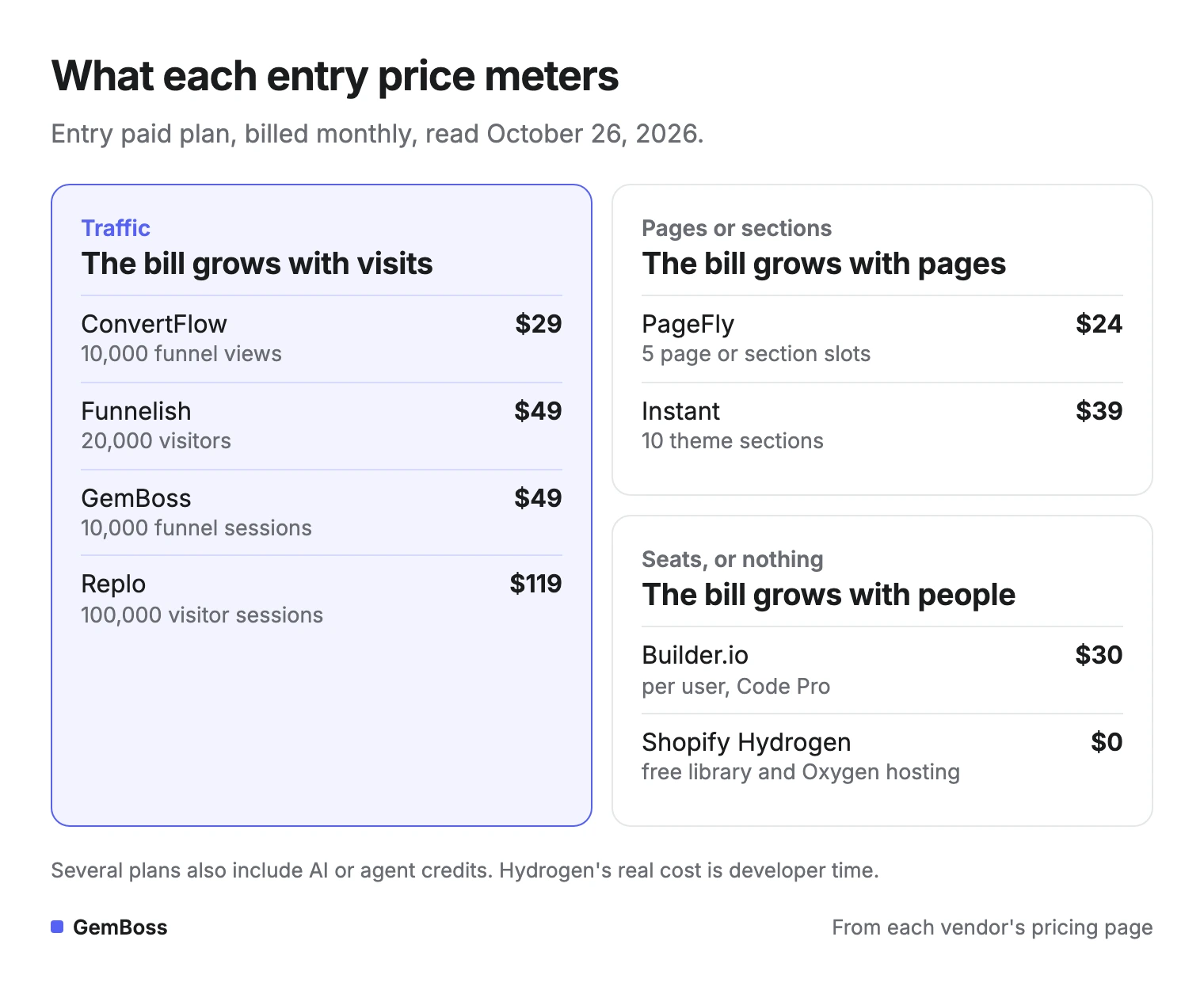
Keeping pages in the theme costs less at the start, with PageFly from $24 and Instant from $39. Neither moves pages out of the theme, so they solve a different problem.
For a whole headless store, see what headless Shopify costs.
Do I need a developer to run a headless funnel on Shopify?
You need a developer for Hydrogen and for Builder.io's Code plans, and you don't for the other six tools in the tables. Their editors and agents publish pages without code, though someone still connects your domain and tracking.
Coding agents narrow the gap. Hydrogen ships 20 skills that teach agents to build the home, collection, product, cart and account pages, yet someone still owns that code after launch.
Nithish Sekar called "the delay between a commercial idea and a live test" ecommerce's biggest hidden cost (post).
Who sells a managed funnel service?
Three tools in this list sell hands-on funnel help when nobody has the hours. Instant (Business) and Funnelish (Enterprise) also sell build or migration help.
- GemBoss Managed, from $690 a month: an operator builds and tests the funnels, and you approve every change.
- ConvertFlow Custom, from $999 a month: a dedicated account manager, monthly optimization meetings and managed funnel building.
- Replo Pro, $599 a month billed monthly: 10 hours of onboarding, a kickoff call with the founders and a 1:1 Slack channel.
Ask each one who reads the tests and who signs off before anything goes live.
Which AI funnel builder is the best?
The best AI funnel builder is the one whose AI drafts the work you lack, while a person still approves what goes live. Ask what the agent drafts end to end: one page, a whole funnel, or the ad angles as well.
Most tools here now draft with AI. PageFly's FlyMate builds pages from a prompt, ConvertFlow's agent builds funnels in chat, and Replo's agent researches, builds and runs sites. Replo lets you decide what its agent can touch and review the plan before big jobs run.
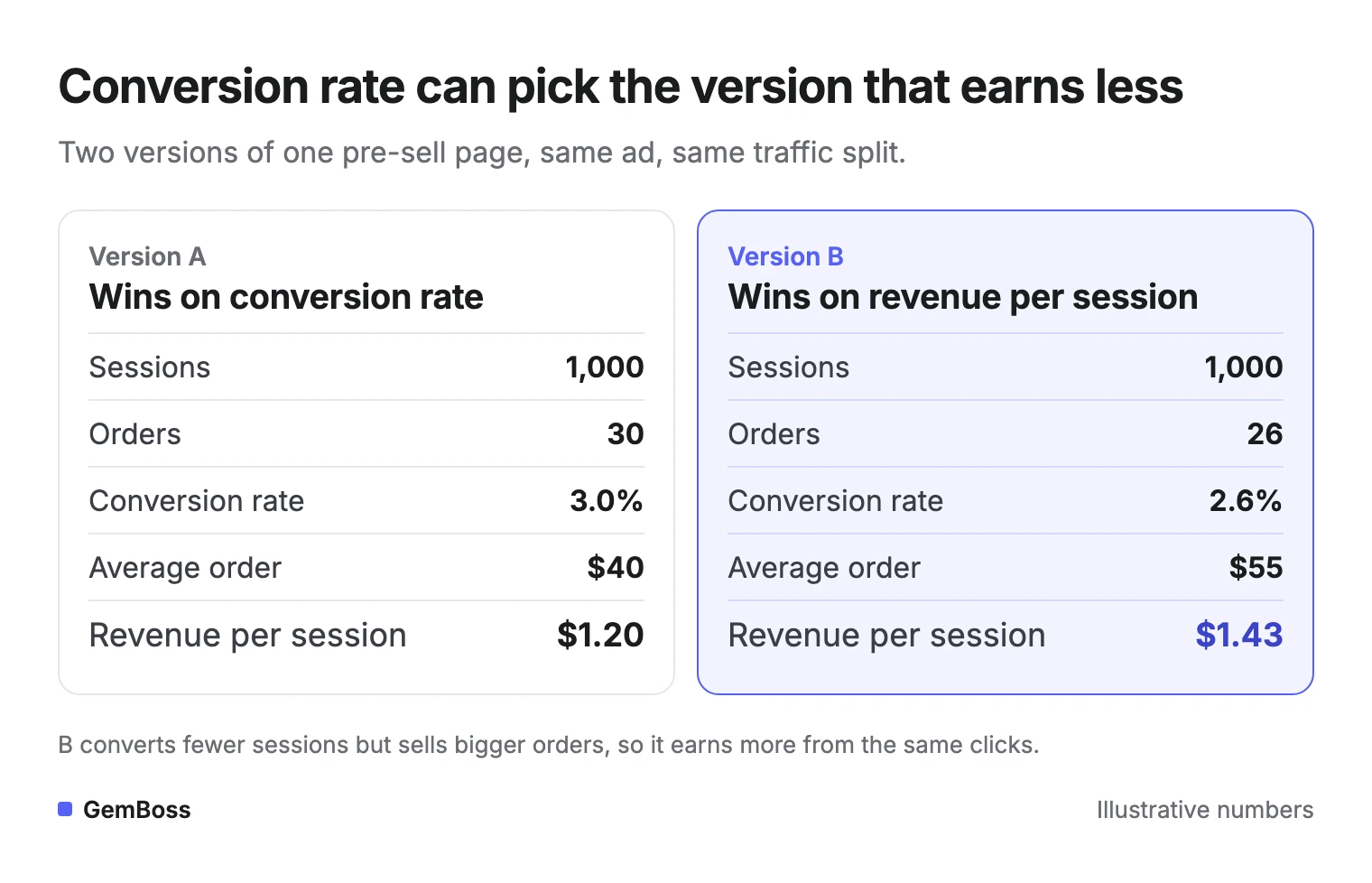
How a tool reads a test matters more, as this made-up example shows.
What to check before you trust a test result
Three checks separate a result you can act on from noise.
- Check which number decides. PageFly lets you pick a metric from add-to-cart rate to conversion rate, Instant tracks revenue per visitor, and ConvertFlow attributes revenue to each variant.
- Check whether the method allows early looks. Evan Miller showed that peeking at a fixed-sample test and stopping on a good day inflates false winners.
- Check who switches traffic to the winner. PageFly publishes a winning variation with one click, and GemBoss waits for a person to promote it.
In Miller's worst-case example, a test meant to be wrong 5% of the time was wrong 26.1% of the time. Sequential methods, like the always-valid tests GemBoss uses, are built to be checked as data arrives. The playbook on testing a funnel without a data team covers the setup on Shopify.
How we checked
On October 26, 2026 we read each pricing page (for Hydrogen, Shopify's changelog), flipped every billing toggle and recorded the monthly price. Replo, Instant and Builder.io open on yearly-billed prices, and PageFly prices two plans on a slider, so we noted the lowest step. Facts on checkout, testing and who does the work come from each vendor's own pages.
We started from the six tools Gemini named for this question on October 25, 2026, and added Funnelish and our own product. We also read the eight articles in Google's top 10 on October 26. We left out an App Store listing and a page from GemPages, our sister product.
Here is what the eight articles contain.
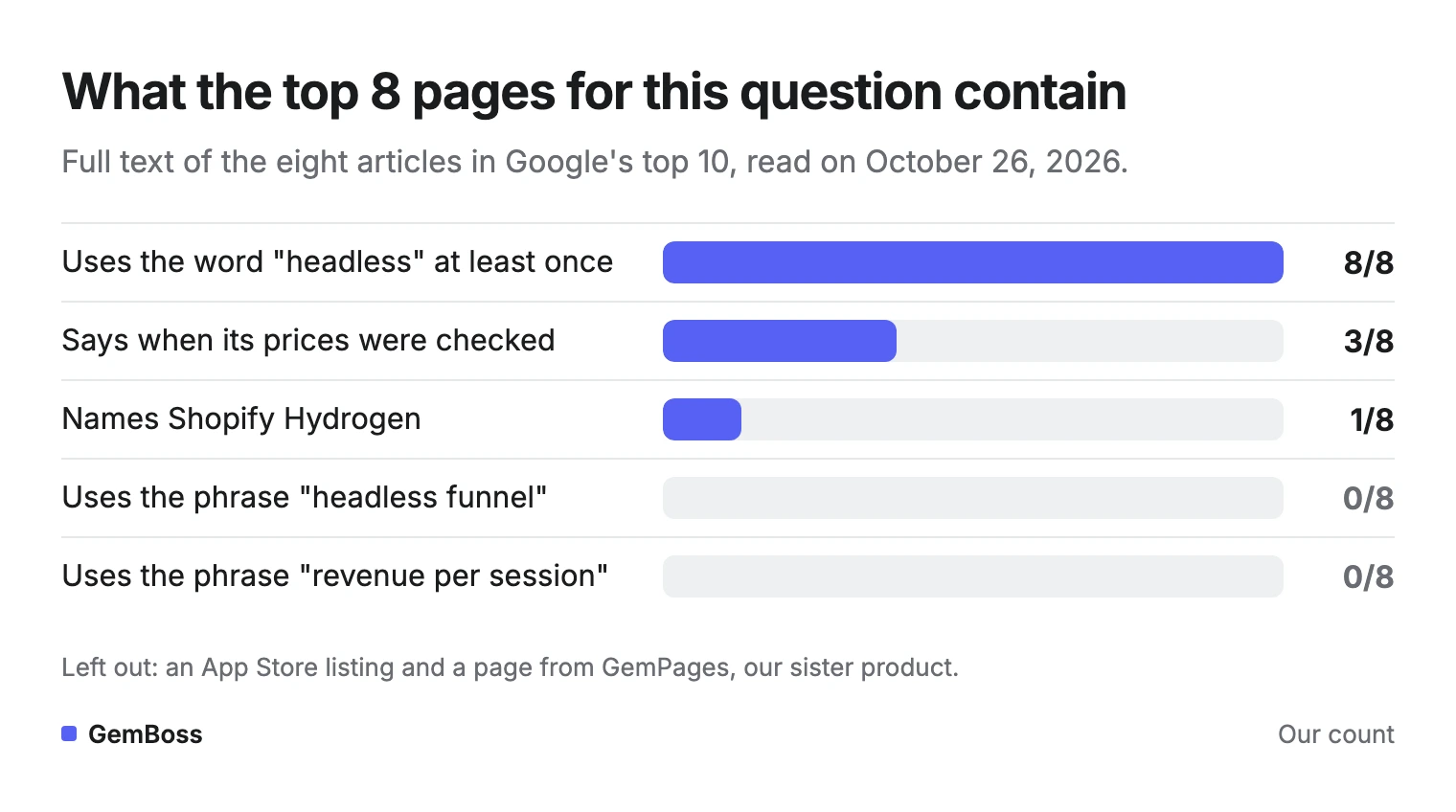
Three pages date their prices: Tagada, TxtCart and Alia. Dash Checkout is the only one that names Shopify Hydrogen, in a single line. We read Blend Commerce's page from a copy saved the same morning, because a second download failed.
If a vendor changes a price after October 26, 2026, its pricing page wins over our table.
How GemBoss handles this
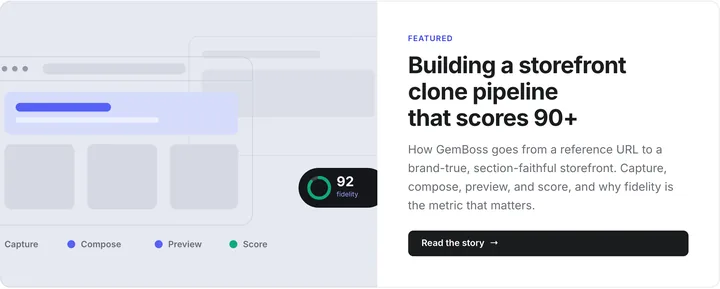
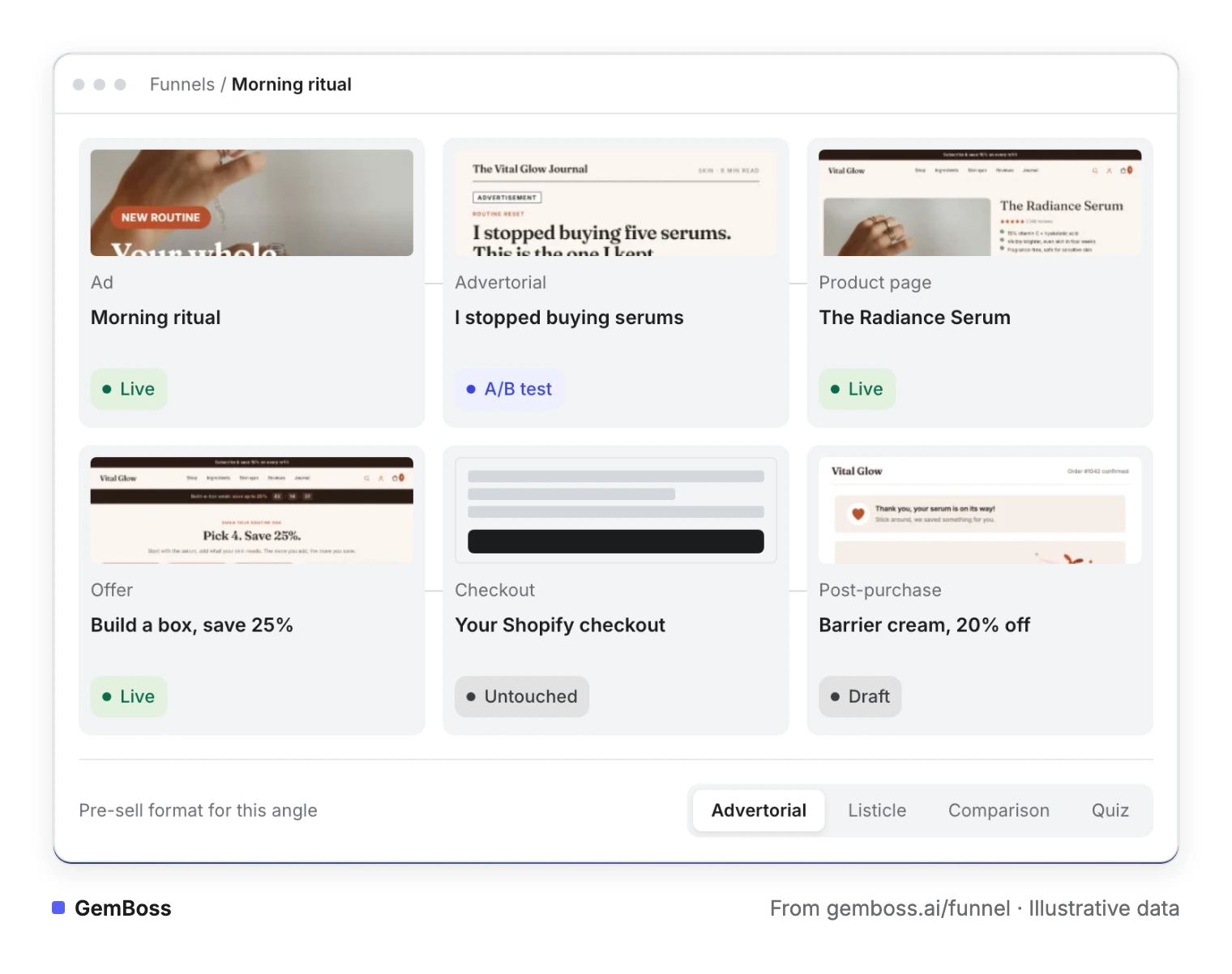
GemBoss is an agentic funnel builder for Shopify brands. Given a product, it writes the angles and builds the path each one needs, from the pre-sell page to the step after checkout (funnel builder).
The pre-sell page can be an advertorial, listicle, comparison or quiz. Tests are always-valid sequential tests read on revenue per session through to the order, and a person promotes the winner (how the engine works).
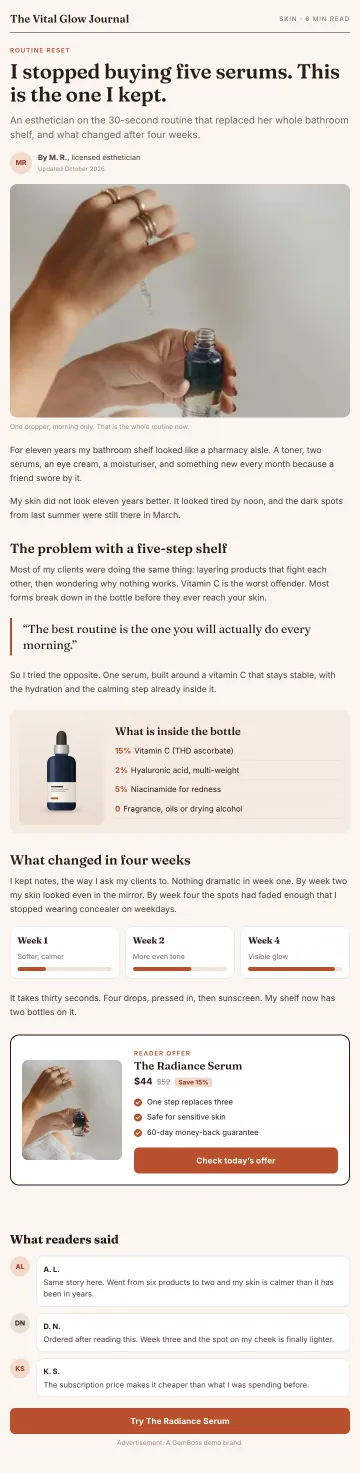
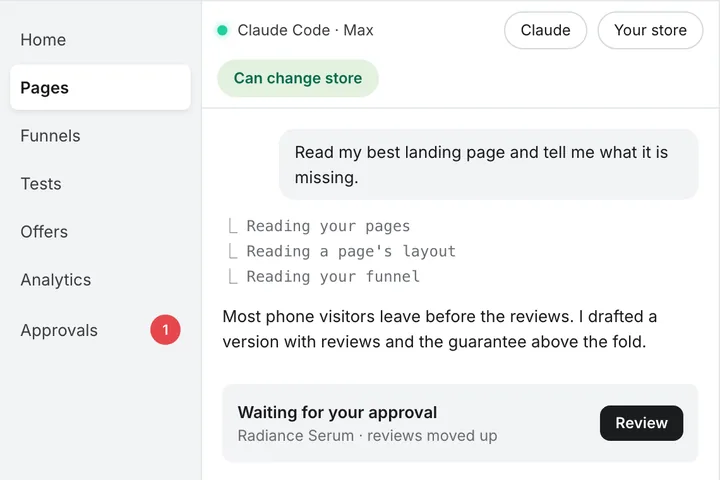
Here is one angle's path on demo data.
The pricing FAQ puts the setup as "Your funnels run on their own pages and checkout stays on Shopify," with your theme serving the rest. Plans start at $49 a month with a 14-day free trial. A headless storefront add-on costs +$99 a month on Growth and Scale.
It writes the angles, ad copy and landing URLs, and you run the campaigns in your own Meta, TikTok or Google account. Server-side purchase events go to Meta only.
It is the wrong choice for in-theme pages (PageFly, Instant), owned code (Hydrogen) or your own checkout (Funnelish).
Frequently asked questions
What is a funnel in Shopify?
A funnel in Shopify is the path a shopper takes from the first click to the order. PageFly's analytics count it as sessions, product views, add to cart, checkout and purchase, and each step can lose the sale. A sales funnel for ads adds a pre-sell page before the product page and an offer after checkout.
What is the best free sales funnel builder?
No free plan in this list covers a tested funnel of several pages. PageFly's and Instant's free plans each publish one page, and Replo's gives 1,000 credits once. Hydrogen is free software but needs developers, and GemBoss has a 14-day free trial instead of a free plan.
What are the best Shopify Hydrogen alternatives?
Builder.io is the option here that also works on your own code. Hosted builders such as Replo replace the developer work for funnel pages. Hydrogen 2026-10 also lets you keep your current framework, so compare other ways to go headless on Shopify before a rebuild.
Is Shopify Hydrogen worth it?
Shopify Hydrogen is worth it when you already run a JavaScript site and have developers, since you now add it instead of rebuilding. Without developers, its free price hides the real cost of building and maintaining the code.
Can I run a funnel outside Shopify and keep Shopify checkout?
Yes: Replo, ConvertFlow and GemBoss serve pages outside your theme and send the order to Shopify's checkout, and Replo can also use its own. Funnelish is the exception, with its own checkout and orders synced back to Shopify. It can also run standalone, without a Shopify storefront.
Sources
- Hydrogen 2026-10 is now available · Shopify developer changelog, October 14, 2026
- Shopify homepage · Shopify, checkout claim read October 26, 2026
- Builder.io pricing · Builder.io, read October 26, 2026
- PageFly pricing, A/B testing and sales funnel · PageFly, read October 26, 2026
- Instant pricing · Instant, read October 26, 2026
- How to start A/B testing your Shopify store · Instant, December 9, 2025
- Replo pricing and homepage · Replo, read October 26, 2026
- ConvertFlow pricing and Shopify landing page builder · ConvertFlow, read October 26, 2026
- Funnelish pricing and homepage · Funnelish, read October 26, 2026
- How Not To Run an A/B Test · Evan Miller, April 18, 2010
- 9 Best PageFly Alternatives · TxtCart, updated October 12, 2026
- Top 10 Shopify Page Builder Apps (2026) · Dash Checkout, July 7, 2026
- Oliver Kenyon (August 5, 2026), Ash (October 16, 2026) and Ben Paine (September 1, 2026) on X, posts linked in the text
- ZAGO Agency (October 25, 2026) and Nithish Sekar (October 18, 2026) on LinkedIn, posts linked in the text
- Screenshot of Replo, captured October 2026 · Replo
A store you own, run for you
See GemBoss build on your brand. Open framework, your data, no lock-in, and keep optimizing it every week.
Request a demo →Want this every morning? GemNews puts a Shopify and AI briefing in every new tab, free.