









 Shop the gift






Shopify Hydrogen alternatives: 3 routes, and which fits you

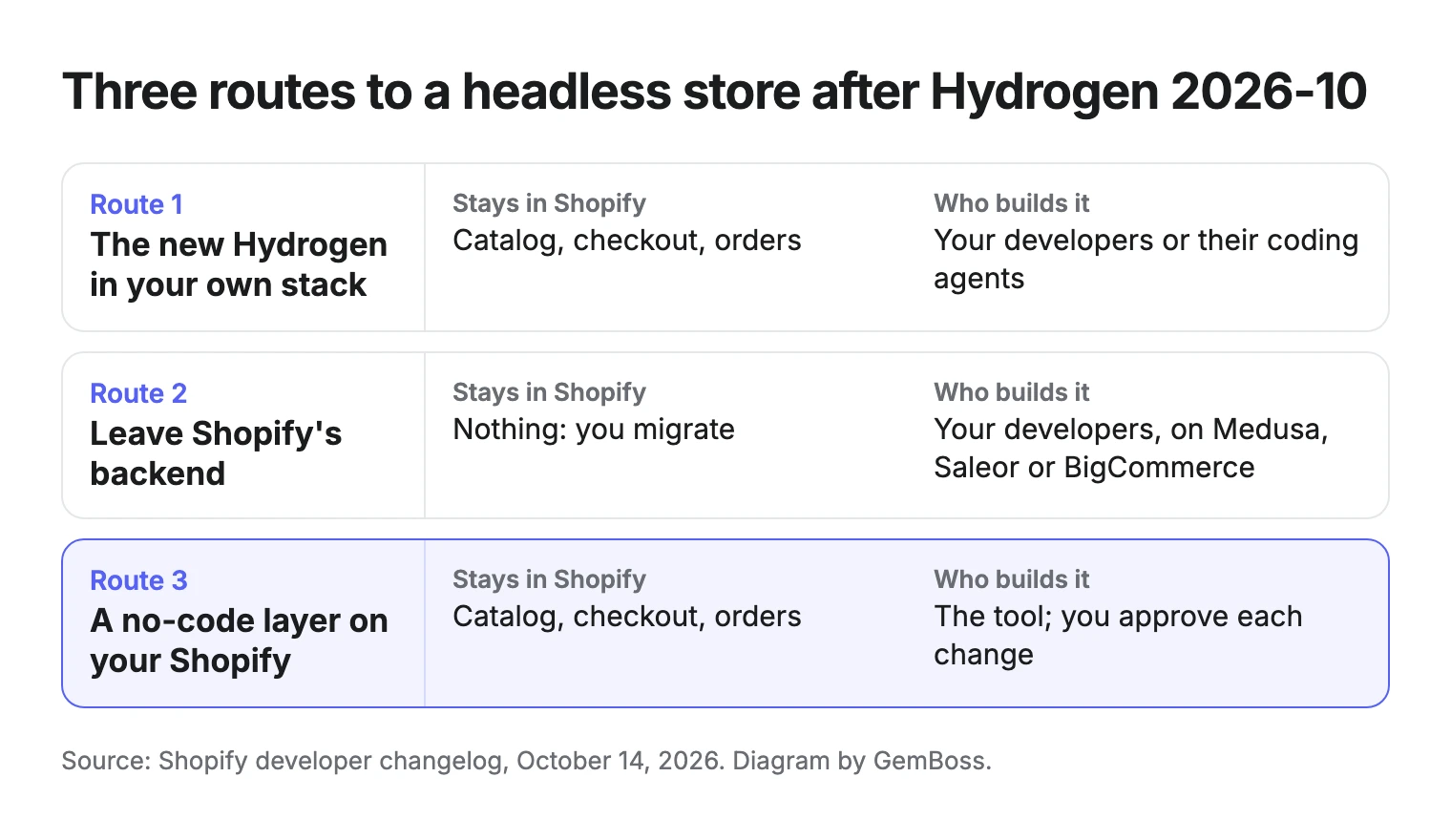
So the Shopify Hydrogen alternatives are now three routes: the new Hydrogen, an open-source engine, or a no-code layer on Shopify.
Updated October 2026: rewritten for Hydrogen 2026-10, with current prices and a route without developers.
Many "Hydrogen alternatives" guides start from one idea: Hydrogen is a full framework, so the alternative is another framework. That stopped being true in October 2026.
The better question is who will build and maintain your storefront a year from now.
The map shows the three routes, what stays in Shopify on each, and who builds it.
Quick answer
- You have developers: use the new Hydrogen inside the stack you already run, Next.js included.
- You want to own the backend: move to an open-source engine such as Medusa or Saleor.
- You have no developers: use a headless layer that keeps Shopify's checkout and orders.
What changed in Hydrogen on October 14, 2026?
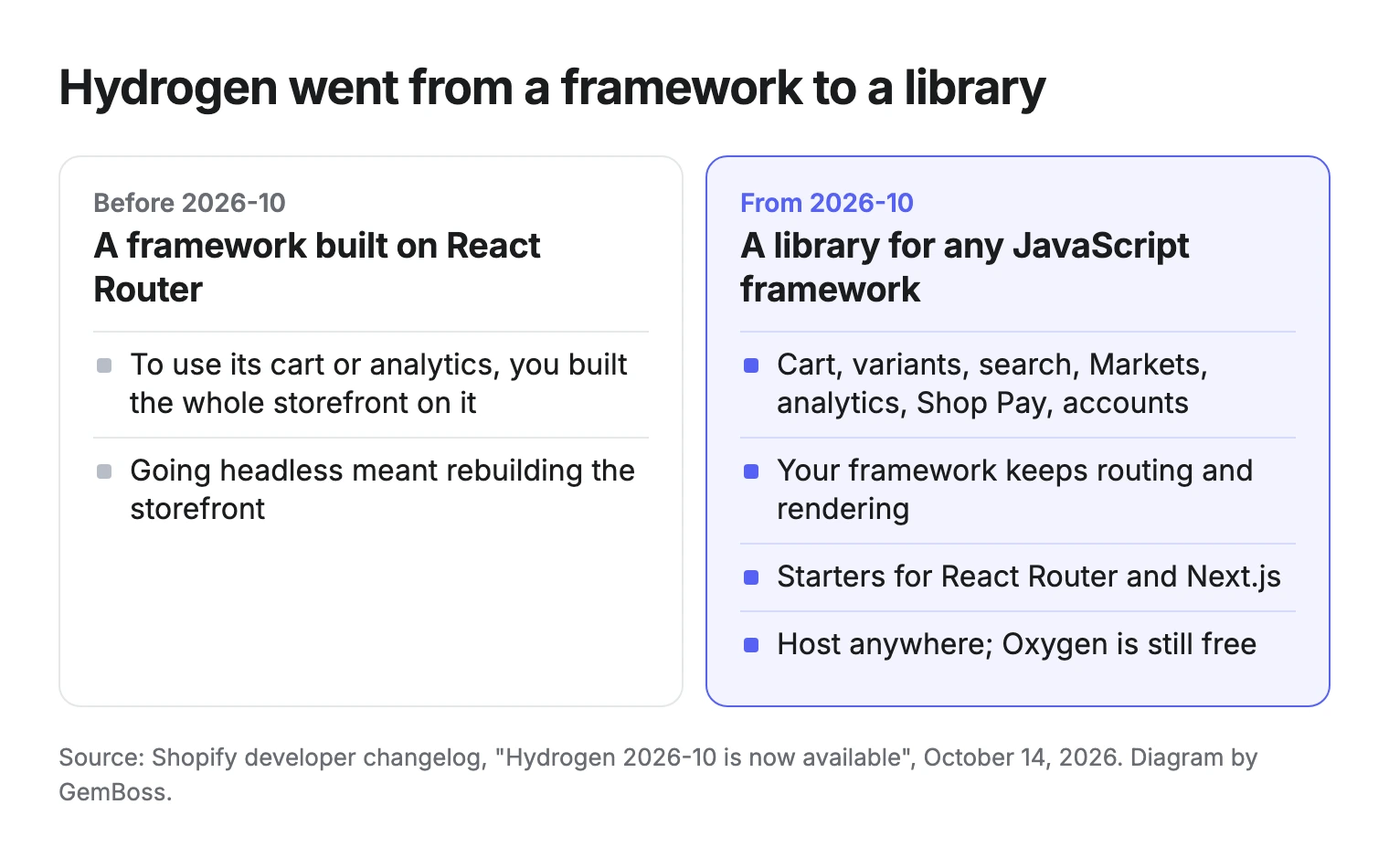
Until this release, Hydrogen was Shopify's React framework for custom storefronts. Going headless with it meant rebuilding the storefront around Hydrogen, then hosting it on Oxygen or somewhere else. That is why "alternative" used to mean "a different framework".
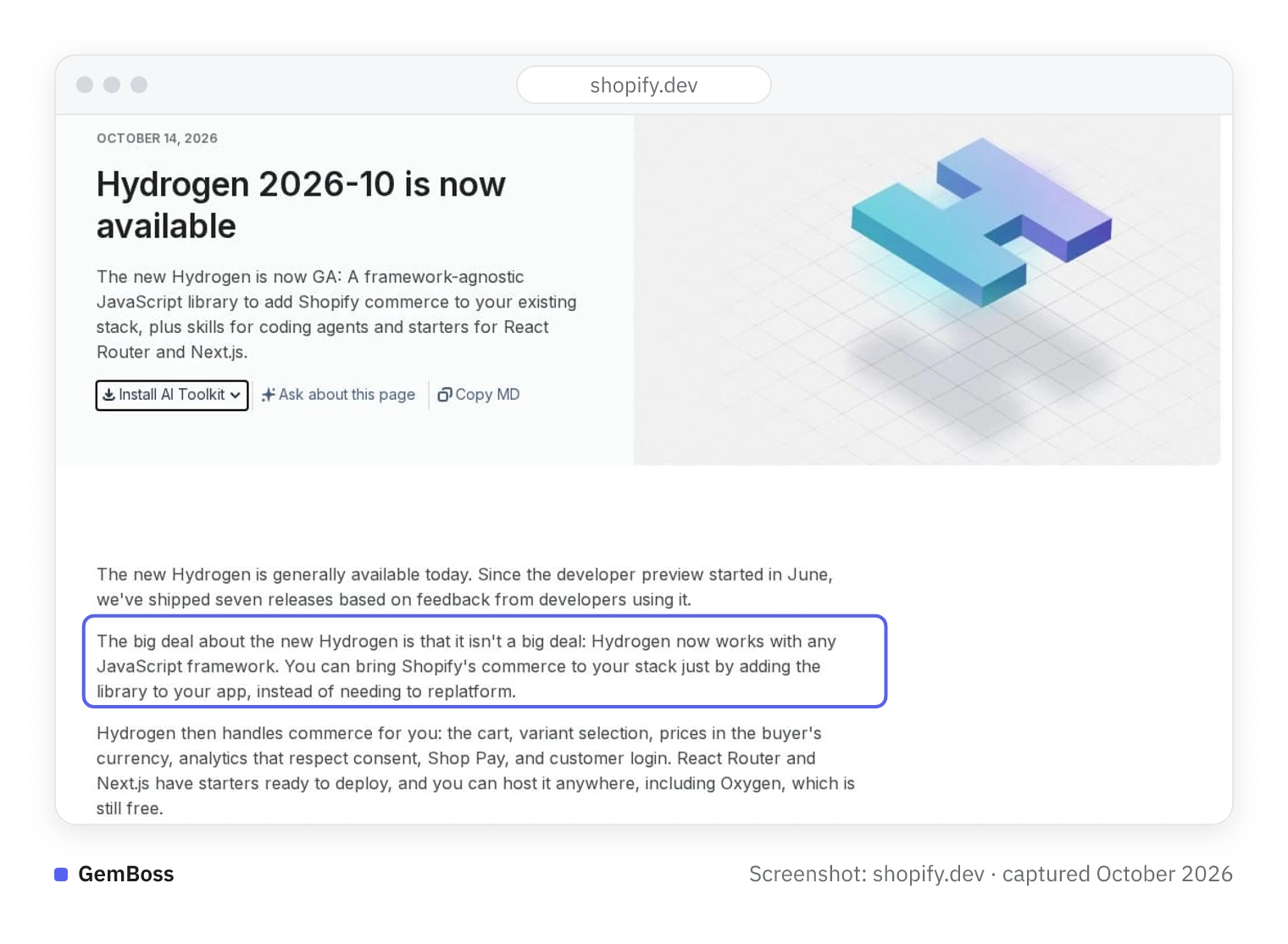
The new Hydrogen works with any JavaScript framework. Shopify says you bring its commerce to your stack by adding the library to your app, instead of needing to replatform.
Shopify's announcement, dated October 14, 2026, makes the point in one paragraph.
The question moved from "which framework" to "who builds it".
Here is the change: one framework for the whole storefront before, one library inside any framework now.
What the library does for you
Hydrogen now handles the commerce parts every storefront needs: the cart, product variants, collection filters, predictive search, Markets, analytics, Shop Pay and customer accounts. Your framework keeps routing, data loading and rendering, and the design stays yours.
Two details change the cost picture. Oxygen, Shopify's hosting for Hydrogen, is still free, and you can host anywhere else. And the package ships 20 skills that teach coding agents how to build with it: ask an agent to "Set up my store with Shopify" and, per Shopify, it builds the home, collection, search, product, cart and account pages, adds analytics and smoke-tests the result.
It is generally available, and it is built for people who write code.
Shopping agents can buy from it
Hydrogen storefronts also work with shopping agents. In browsers that support WebMCP, an agent can search your catalog and update the cart. After the buyer confirms, Shopify Checkout can submit the order. Shopify says you do not have to build anything for this.
That matters if more of your traffic starts to arrive through an assistant.
Already on the old Hydrogen?
Existing Hydrogen storefronts keep working, and Shopify says there is nothing you need to do. When you are ready, a migration skill walks your coding agent through the move. You keep your pages and routes and change where the commerce code comes from.
So an old Hydrogen build is no reason to look for an alternative in a hurry.
Who gains the most
Nithish Sekar, a Shopify developer and CRO specialist, read the launch differently on LinkedIn: "Shopify’s new Hydrogen release is more interesting for merchants than for developers." His reason is speed. When storefront work is cheaper to ship, a team can test more ideas and rebuild less.
That is true for merchants with a developer on call.
For merchants without one, the library is still code someone has to write.
Shopify Hydrogen alternatives, side by side
| New Hydrogen in your stack | Leave Shopify's backend | No-code layer on Shopify | |
|---|---|---|---|
| What stays in Shopify | Catalog, checkout, orders | Nothing | Catalog, checkout, orders |
| Who builds the storefront | Your developers or their coding agents | Your developers (Your Next Store adds an AI builder that edits code by chat) | The tool; you approve each change |
| Hosting | Oxygen (free) or anywhere | Your choice | Run by the tool |
| Software from | Shopify plan from $29/mo (annual) | Medusa free to self-host; Saleor Cloud from $1,599/mo; BigCommerce from $29/mo (annual) | Shopify plan, plus GemBoss Growth $149/mo and the $99/mo storefront add-on |
| Main cost | Developer time to build and maintain | A full migration | The monthly plan |
| Fits | Teams with a front-end codebase | Teams that want to own the data model | Brands with no developers |
Shopify's plan price is as listed by Your Next Store's comparison of Hydrogen alternatives (September 2026). Medusa, Saleor and BigCommerce prices are from their own pricing pages, and GemBoss prices from gemboss.ai/pricing, all read on October 25, 2026. All are software prices only. On both routes that keep Shopify's backend, apps that work on orders, checkout or the back office keep working; theme app blocks need a check.
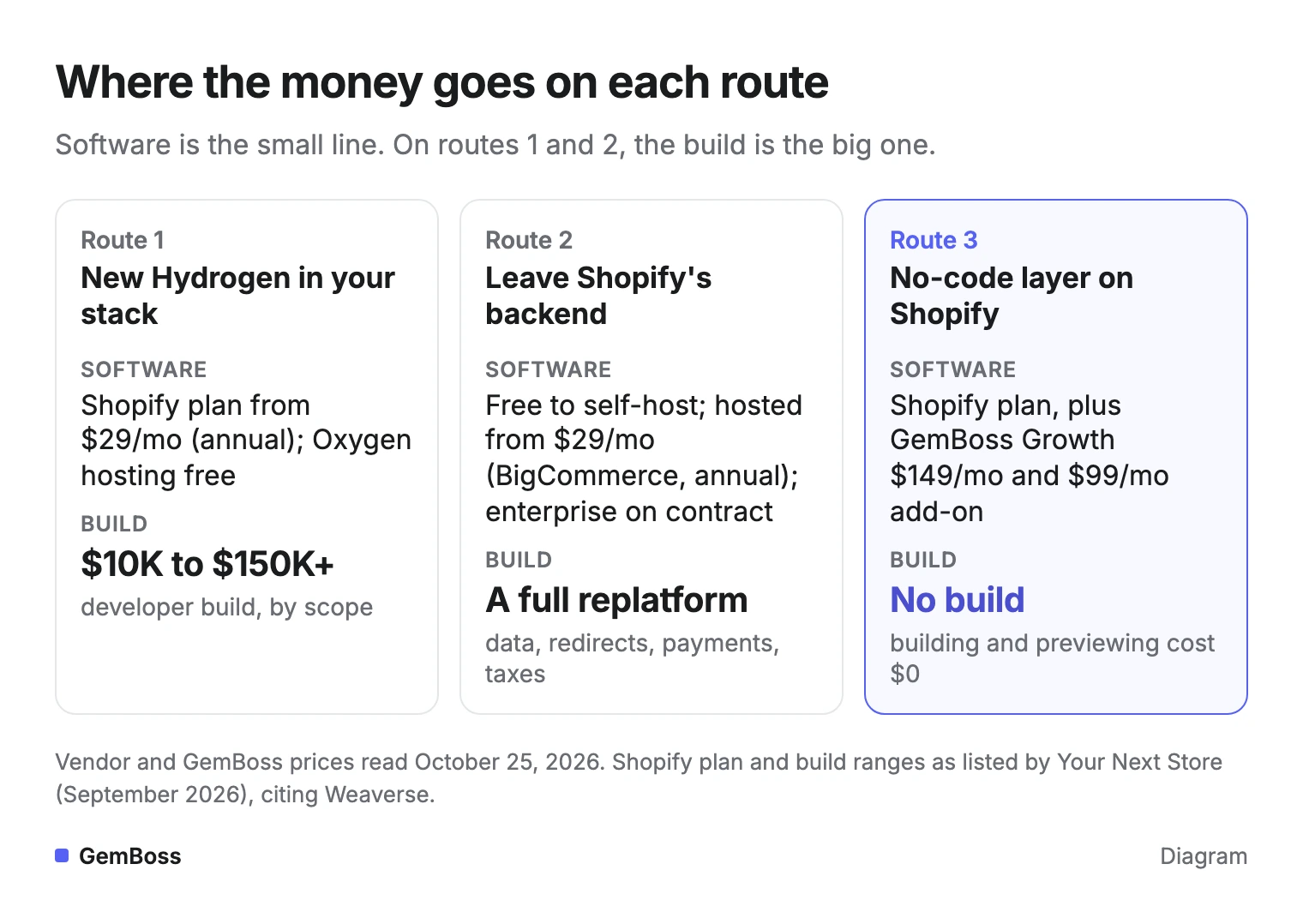
In routes 1 and 2, the build costs more than any line in this table.
Here is that split, route by route.
Route 1: keep Hydrogen, inside the stack you already run
This route fits a brand that already has a front-end codebase and the people to maintain it. You add the library to your app, keep Shopify's checkout and Shop Pay, and keep your own framework for everything the shopper sees.
Before October, teams often had to choose between Hydrogen and Next.js. Commerce-UI's guide to choosing a Shopify headless stack walks through that choice scenario by scenario. Now Hydrogen ships a Next.js starter, so the two can sit in one app.
The framework is free; the people are the cost.
What it costs in practice
The software bill is small. Your Next Store lists the Shopify plans under a Hydrogen storefront at $29 a month (Basic, billed yearly), $79 (Grow), $299 (Advanced) and $2,300 or more for Shopify Plus. Oxygen hosting is free.
The build is where the money goes. Your Next Store cites Weaverse's 2026 pricing breakdown: $10K to $25K for a lean Hydrogen build, $25K to $60K for a growth build with a real design system, and $60K to $150K or more for B2B or multi-market. Both companies sell alternatives to a custom build, so treat these as their ranges.
Budget for the build first.
If you host on Oxygen
Plan for its limits. Shopify's Hydrogen and Oxygen fundamentals, now in its legacy docs, list 30 seconds of CPU time per request and 128 MB of memory per worker. Heavy server work belongs somewhere else.
Pick this route if
- You already run a React Router or Next.js app, or plan to.
- You have a developer who will still own the code in a year.
- You want Shopify checkout, Shop Pay and Markets without building them yourself.
Skip it if nobody on your team writes code.
A coding agent can write the first version, but someone still has to review it, fix it and keep it running.
Starting on Next.js
If you use Next.js, Shopify points to Vercel Shop, a storefront built on Hydrogen and maintained by Vercel. It replaces Next.js Commerce: Vercel archived that repository on October 20, 2026 and marked the template deprecated.
Start new Next.js builds from Vercel Shop.
Route 2: leave Shopify's backend
Some teams search for a Hydrogen alternative when they really want an alternative to Shopify. For them, the storefront framework is a small part of the decision.
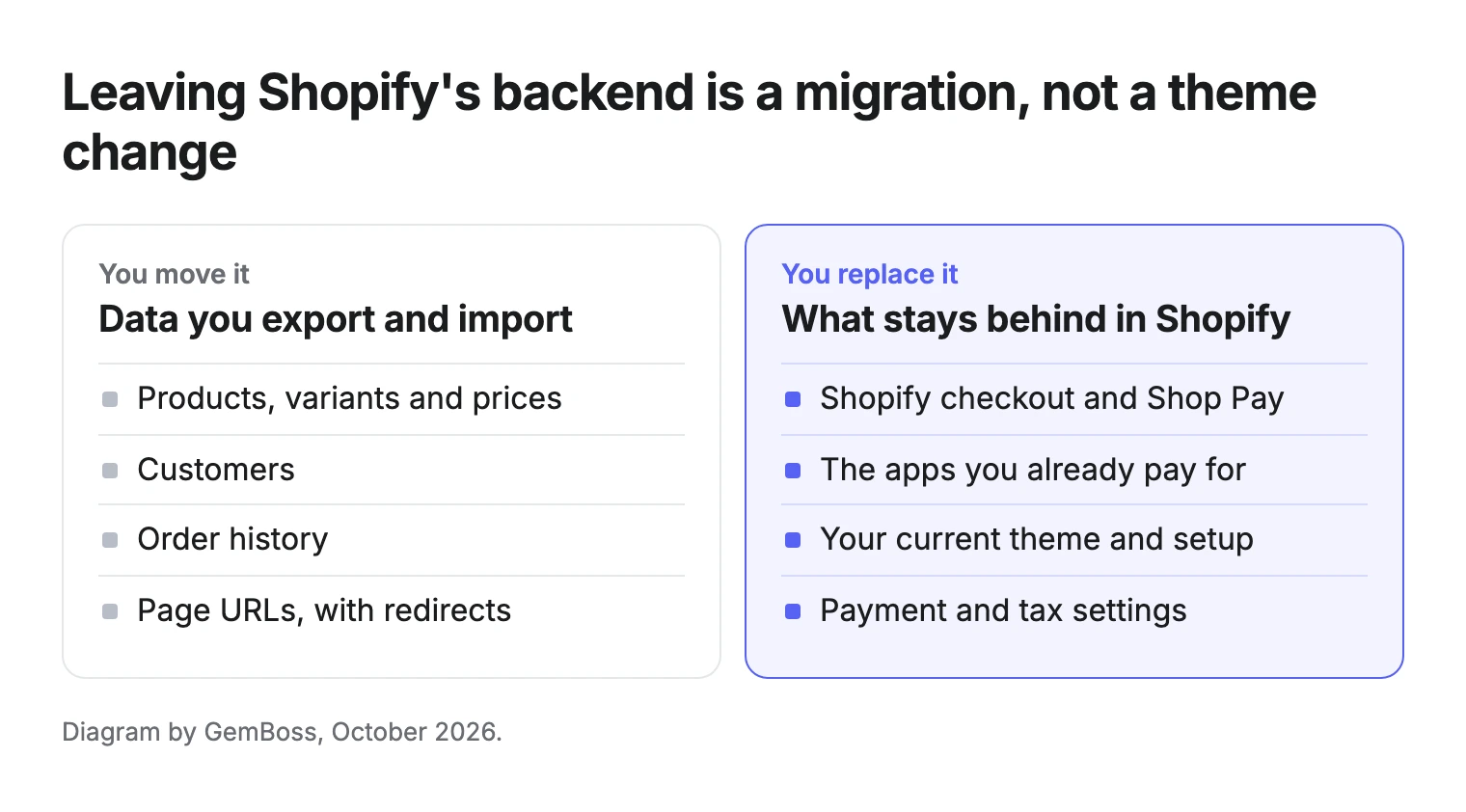
Here is what moves and what stays behind when you leave.
Your Next Store's comparison lists nine options; the eight below move commerce off Shopify.
| Option | What it is | Starting price |
|---|---|---|
| Your Next Store | Managed backend with an open-source Next.js storefront | $30/mo |
| Medusa | Open-source engine (Node, TypeScript) | Free to self-host; Cloud from $29/mo |
| Saleor | Open-source engine (Python, GraphQL) | Free to self-host; Cloud from $1,599/mo |
| Vendure | Open-source framework (NestJS, GraphQL) | Framework free under GPLv3; paid plans from $229/mo on a 12-month term |
| BigCommerce | Hosted platform, Catalyst for headless | $29/mo, billed annually |
| Swell | Hosted headless platform | $29/mo (annual) |
| commercetools | Composable commerce for enterprise | Custom contract |
| WooCommerce | WordPress plugin with a Store API | Free, plus hosting |
The ninth, Next.js Commerce, stayed on Shopify and is now deprecated. Linked prices are from each vendor's pricing page, read on October 25, 2026; the rest are as listed by Your Next Store in September 2026. Payment processing fees come on top.
What you gain and what you give up
You gain full control of the data model and the backend. That matters for unusual catalogs, custom pricing logic or B2B rules that do not fit Shopify.
This is a replatform, and it should be priced like one.
You give up Shopify's checkout and Shop Pay, the app ecosystem you already pay for, and the work you put into your current setup. You also take on a migration: products, customers and order history move, old page URLs need redirects, and payments and taxes need a new setup.
Choose this route when the backend is the reason.
Route 3: a headless layer, without developers
This route fits a brand on a Liquid theme that wants headless speed and design but has no developers. A no-code tool builds the storefront on top of your Shopify. Shopify keeps the catalog, checkout, orders and apps, so nothing moves.
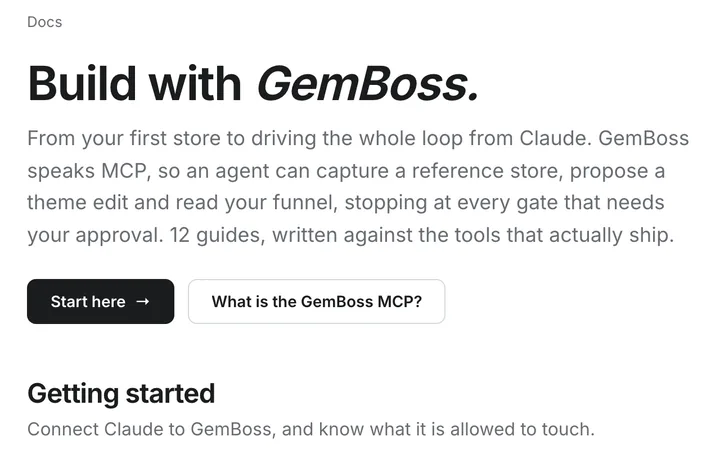
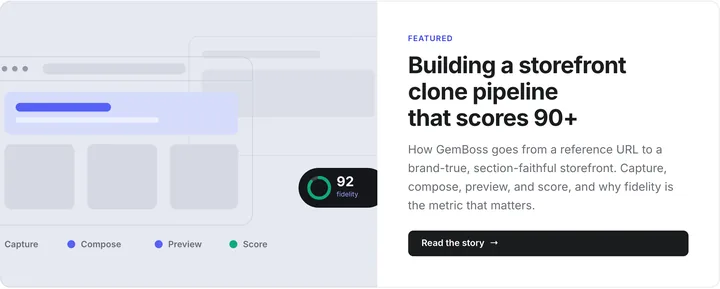
GemBoss, which publishes this blog, works this way.
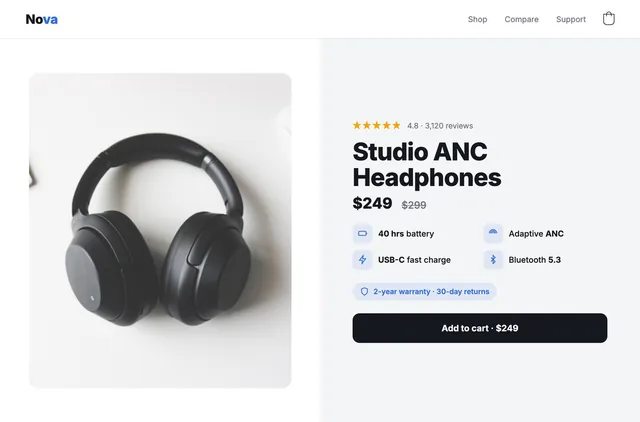
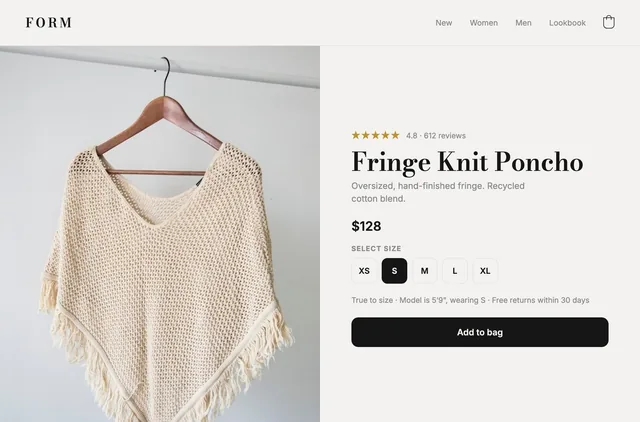
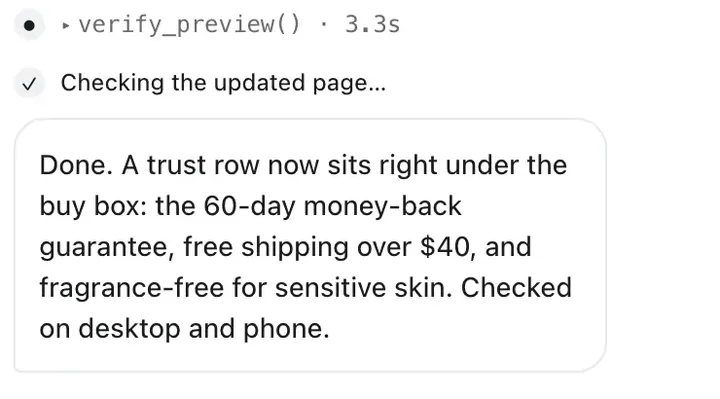
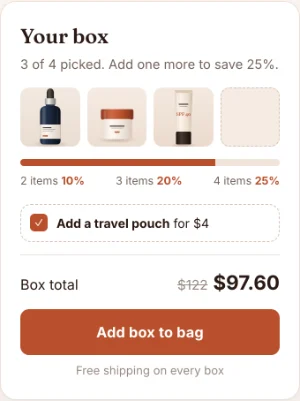
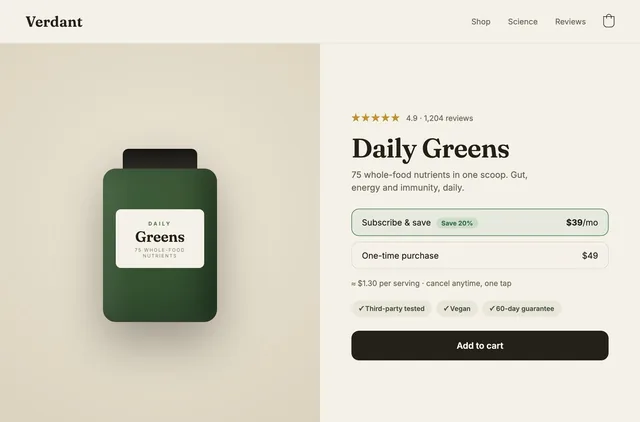
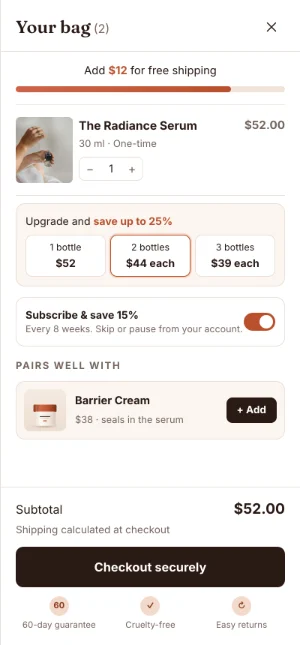
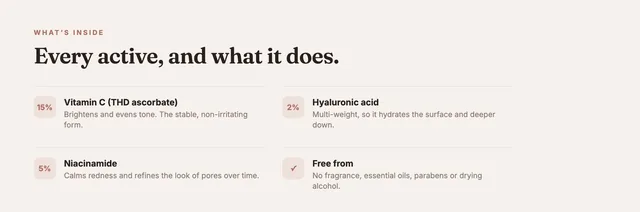
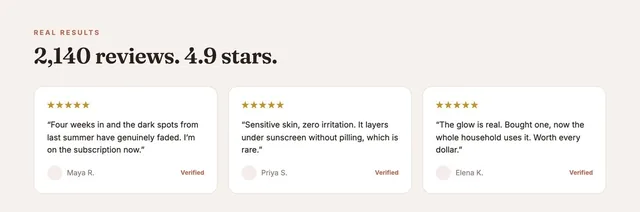
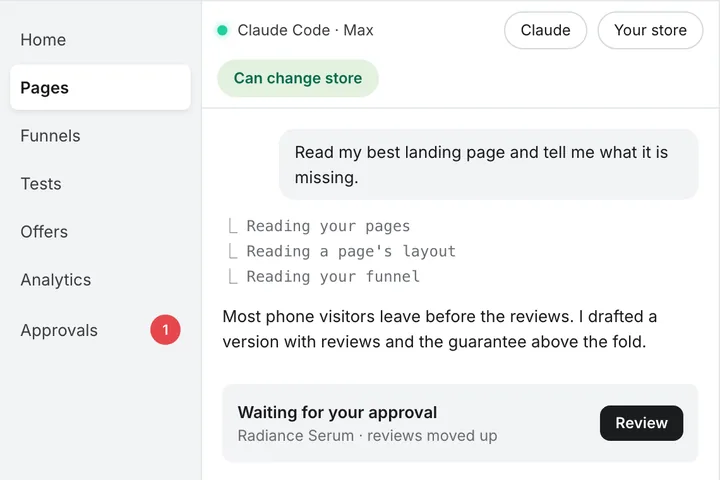
You describe your brand or point it at a store you like, connect your Shopify, and it composes home, collection and product pages from 60 section types. The AI store builder page shows the steps; the screens below come from demo brands.
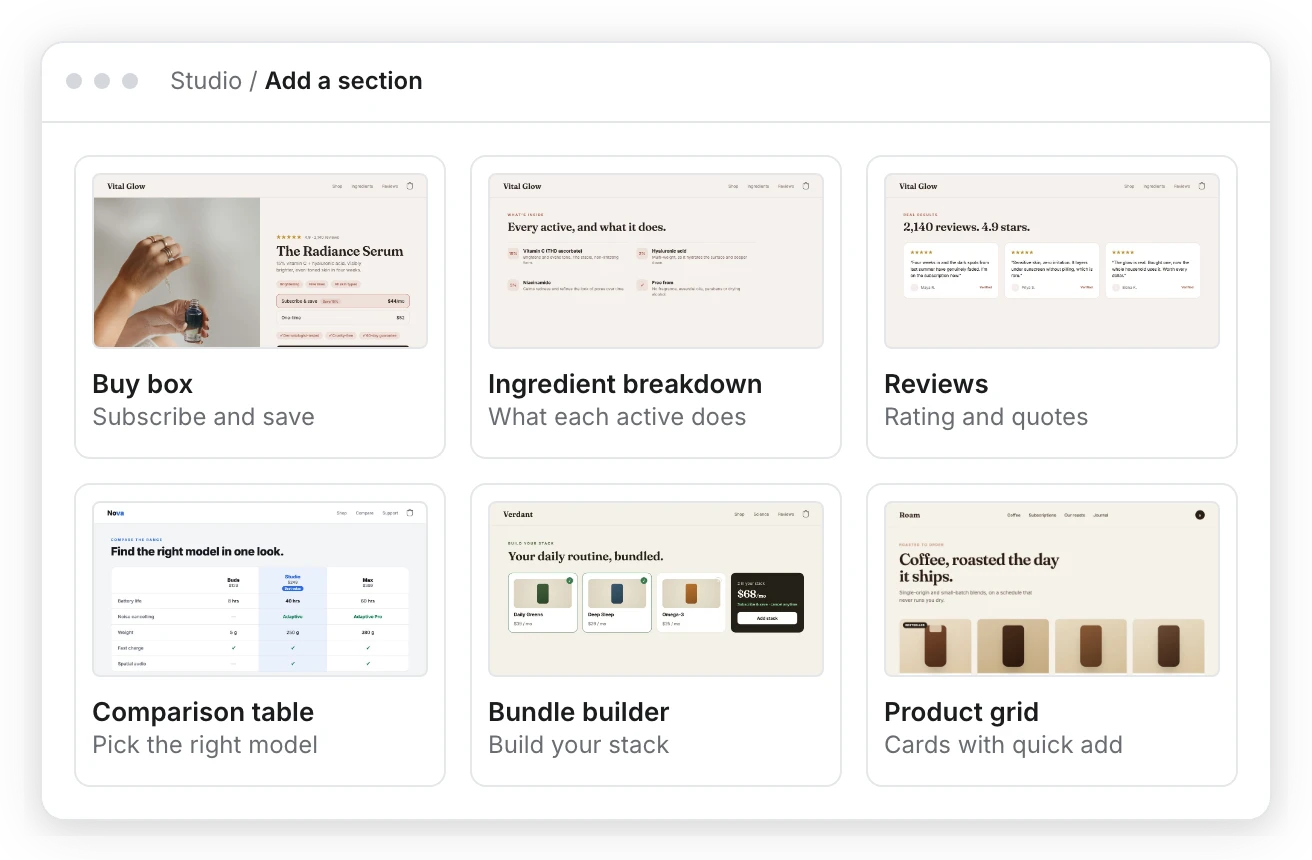
Nothing goes live until you approve it.
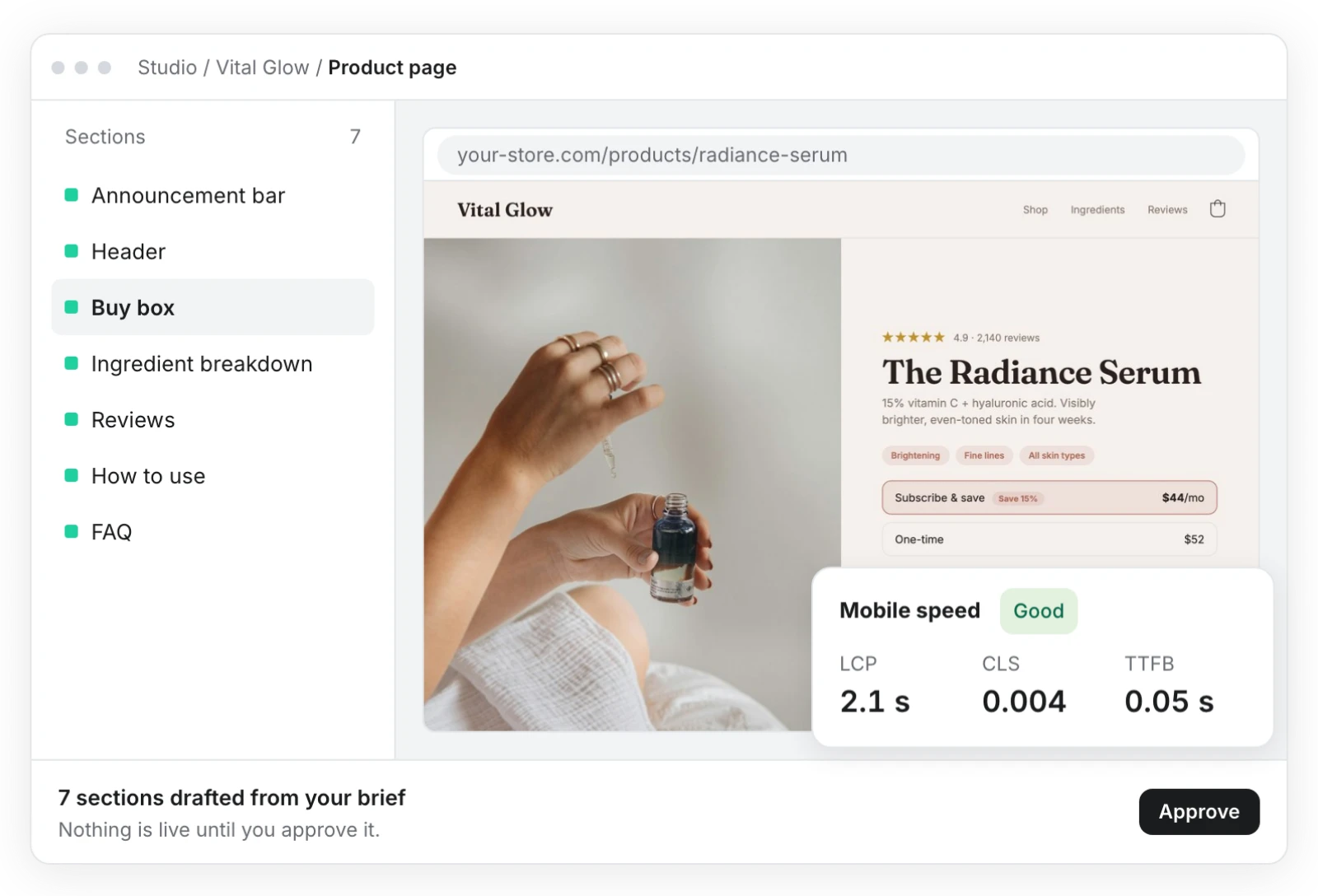
You keep Shopify. Only the storefront changes.
What it costs, and what it does not do
The headless storefront is an add-on on the Growth plan ($149 a month) and the Scale plan ($399 a month): $99 a month for up to 100,000 storefront sessions, and $299 for up to 500,000. It is not on the $49 Starter plan. Building and previewing costs $0 before you pick a plan, and each plan has a 14-day free trial.
On speed, GemBoss measured a live store on mobile at LCP 2.1 s and CLS 0.004 (simulated 4G, median of 8 Lighthouse runs, October 10, 2026). For why those two numbers matter to revenue, see headless commerce and Core Web Vitals.
An unusual checkout flow or deep custom logic still needs developers, so route 1.
What other Hydrogen alternatives guides miss
We checked the nine Google results for "shopify hydrogen alternatives" on October 25, 2026 (eight could be measured) and studied the top three closely. They are useful, and they share gaps:
- They predate the change. Vervaunt's pros-and-cons guide, ranked first, is dated January 2023, and Your Next Store's comparison is dated September 25, 2026, three weeks before Hydrogen 2026-10.
- They compare frameworks and skip the owner. They ask which stack to pick, and skip who will build and maintain it.
- Every option needs developers or leaves Shopify's backend. None prices a route that keeps Shopify checkout without a developer.
- A vendor ranks itself. Your Next Store lists its own product first, and Shopify's own Hydrogen page in the results now sits under its legacy docs.
Start with the owner question, because the price follows from it.
Which route fits you? Three questions
Answer them in order; the first answer that points to a route is yours.
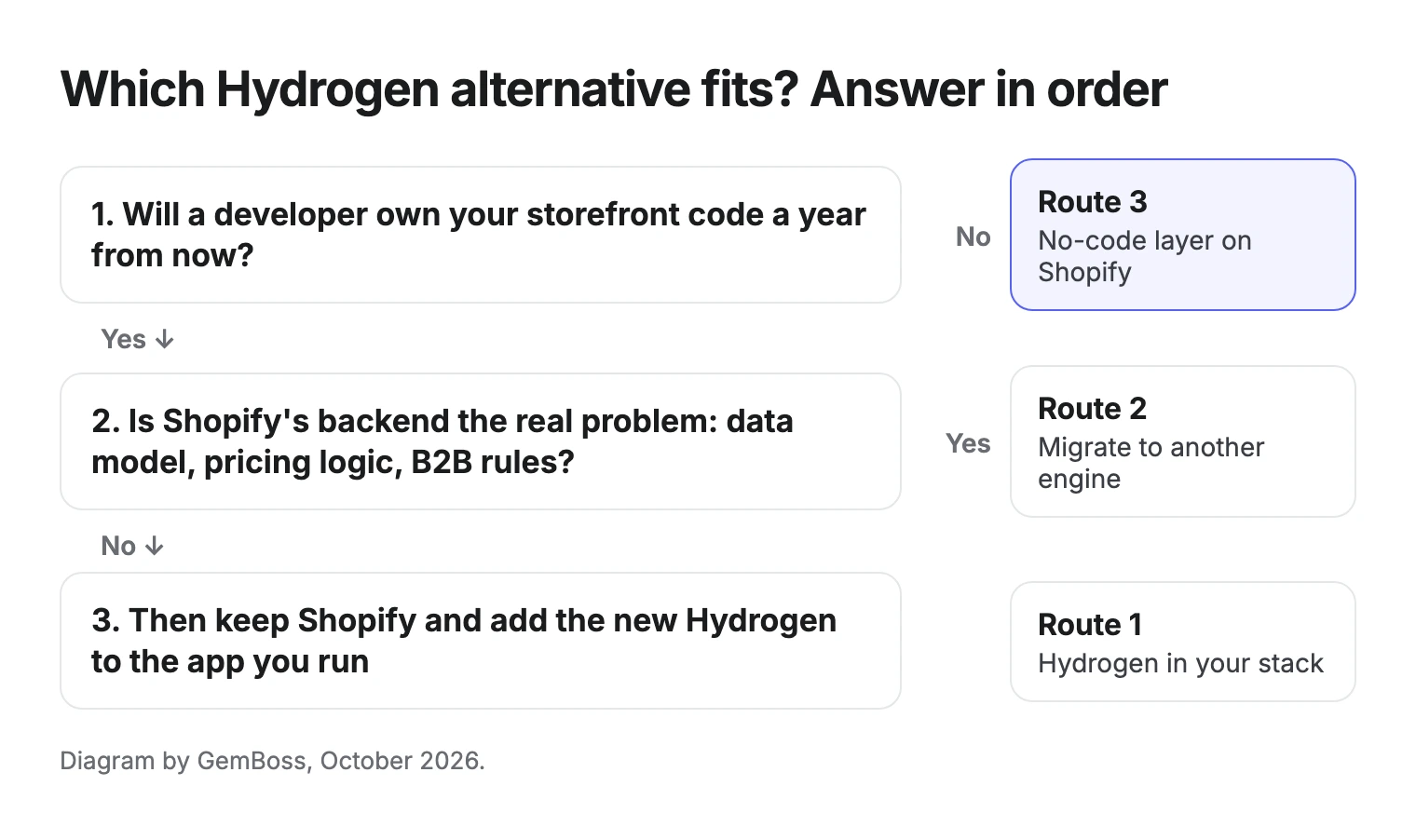
- Will a developer own your storefront code a year from now? If not, take route 3.
- Is Shopify's backend the real problem (data model, pricing logic, B2B rules)? If yes, take route 2 and budget a migration.
- Neither? Take route 1, and start inside the app you already have.
If you are still choosing between headless and a theme, read headless Shopify vs Liquid themes first.
Is Shopify Hydrogen worth it in 2026?
For teams with developers, yes, and more than before. The framework is free, Oxygen is free, and you no longer have to rebuild your app around Hydrogen to use it.
The build was always the cost, and October did not change it.
For teams without developers, a no-code layer is the realistic path. What headless Shopify costs covers the full numbers on each side.
What to do this week
- Write down who maintains your storefront in 12 months. If the honest answer is nobody, cross off routes 1 and 2.
- If you have developers, run
npx @shopify/hydrogen@latest setupin a branch of your current app before you plan a rebuild. - If you have no developers, build a preview of one product page with a no-code layer and open it on your phone next to your current page.
Frequently asked questions
Is Hydrogen Shopify free?
The Hydrogen library is free, and Shopify's changelog says Oxygen hosting is still free. You still need a Shopify plan, from $29 a month on annual billing, and someone to build the storefront.
Is Shopify Hydrogen being discontinued?
No. Hydrogen changed shape on October 14, 2026: it is now a library you add to any JavaScript framework. Shopify says existing Hydrogen storefronts keep working and there is nothing you need to do. When you are ready to move, a migration skill guides your coding agent.
Can I host Hydrogen outside Oxygen?
Yes. Shopify's changelog says you can host the new Hydrogen anywhere, including Oxygen, which is still free. Starters exist for React Router and Next.js. If you stay on Oxygen, check its limits; Shopify's legacy docs list 30 seconds of CPU time per request and 128 MB of memory per worker.
Do I need a developer for a headless store?
For routes 1 and 2, yes. Coding agents speed up the work, but a person reviews and maintains the code. For route 3, no: the tool builds the storefront and you approve each page. Our guide to headless Shopify without a developer goes step by step.
Should I choose Hydrogen or Next.js?
Since October 2026 you can use both. Hydrogen ships a Next.js starter and adds Shopify commerce, such as the cart, Shop Pay and customer accounts, to a Next.js app. So the choice comes down to people: pick the framework your developers already know and will still maintain a year from now.
What happened to Next.js Commerce?
Vercel archived the Next.js Commerce repository on October 20, 2026 and marked the template deprecated. Development moved to Vercel Shop, a Shopify storefront built on Next.js, which Shopify also points to as a starting point for Next.js teams.
Who is Shopify's biggest competitor for a headless store?
Your Next Store's comparison calls BigCommerce the closest SaaS equivalent to Hydrogen: a managed backend with Catalyst, its own maintained Next.js storefront. For enterprise programs with a platform team, it points to commercetools.
Sources
- Shopify developer changelog, Hydrogen 2026-10 is now available, October 14, 2026, and Hydrogen and Oxygen fundamentals.
- Your Next Store, Shopify Hydrogen alternatives, dated September 25, 2026, citing Weaverse's 2026 pricing breakdown.
- Vendor pricing pages read October 25, 2026: Medusa, Saleor, Vendure, BigCommerce.
- Vercel, Vercel Shop template and the archived vercel/commerce repository.
- Commerce-UI, Hydrogen vs Next.js: how to choose a Shopify headless stack.
- Nithish Sekar on LinkedIn.
- GemBoss, pricing and AI store builder pages, October 2026. Product screens come from demo brands on gemboss.ai and use illustrative data.
- Screenshot of Shopify's developer changelog, captured October 2026
See a store built on your brand
Bring a store you admire or describe your brand. GemBoss captures it, ships a brand-true storefront, and keeps optimizing after launch.
Request a demo →Want this every morning? GemNews puts a Shopify and AI briefing in every new tab, free.