








 Shop the gift






Storefront on Autopilot? Why Every Change Still Needs Your Yes
Automation that keeps a human at the wheel, so the store improves without going rogue.
People look for a storefront on autopilot when they want AI to do the mechanical work of conversion optimization: generating experiments, splitting traffic, and reading results. GemBoss does that work, and a human approves every launch and every winner before it reaches shoppers. Ecommerce automation done this way is not "set it and forget it." It is a continuous loop where the machine does the labor and you keep the decisions, from the GemBoss dashboard.
Quick answer
- The AI runs the CRO loop continuously: find the leak, build the test, measure, recommend.
- A human approval gate keeps it safe: nothing ships to all shoppers without a yes.
- GemBoss never ships on its own: every test launch and every winner waits for your approval.
- Every change waits for your approval in the dashboard, so nothing ships that you have not seen.
- GemBoss builds this into its Operate layer via its own A/B tests.
What does "storefront on autopilot" actually mean?
It means the optimization work happens without you doing it by hand, but not without your consent.
The phrase "autopilot" scares some founders, and reasonably so. Plenty of AI tools promise automation and deliver chaos: off-brand copy live on the homepage, a discount running that nobody approved, changes you cannot explain. That is automation without a driver.
A storefront on autopilot done responsibly keeps the human in the loop by design. The AI handles the parts that are mechanical and endless:
- Watching how shoppers behave.
- Finding where they drop off.
- Proposing an experiment to fix it.
- Building the variant.
- Running the split test to statistical significance.
- Bringing you a clear recommendation.
You handle judgment: does this fit the brand, is the risk acceptable, does it ship. That division is the whole model. The machine is tireless at labor; you are irreplaceable at judgment.
Why not just fully automate it?
Because a storefront is your brand and your revenue, and full automation removes the one thing that keeps both safe.
There is a real tradeoff here. Full automation is faster in the moment but removes accountability: when the machine ships whatever it wants, mistakes reach all your shoppers before anyone notices. A human approval step costs a little speed and buys a lot of safety.
For most brands, that trade is obviously worth it. You are not optimizing an anonymous test site. You are changing the store that pays your bills. The value is not "AI does everything." The value is "AI does the exhausting 90%, and you make the call on the 10% that matters." This is the same argument behind AI conversion optimization as a whole.
How GemBoss handles approval
GemBoss runs one way: it proposes and checks, and you decide.
- It finds and builds. It spots where shoppers drop off, proposes an experiment, and builds the variant.
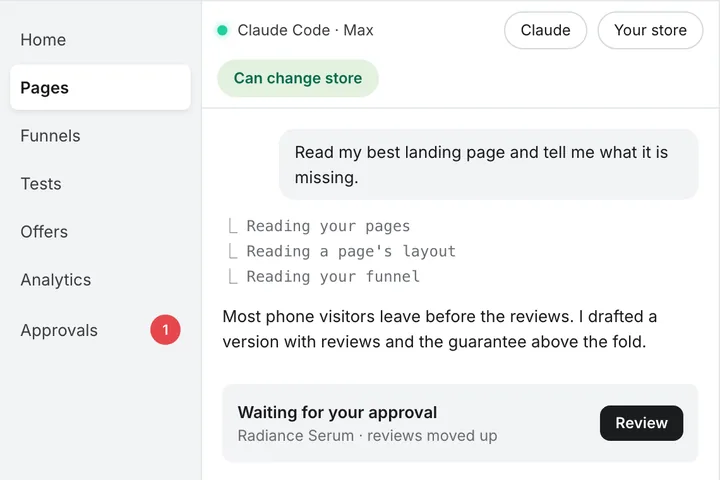
- You approve the launch. No test starts on real shoppers until you say yes.
- You approve the winner. When a test reaches significance, GemBoss brings you the result, and the winning version ships only after you approve it.
There is no mode in which it ships on its own. That is what "storefront on autopilot" should mean for a brand: the work runs around the clock, and the decisions stay yours.
Where do you approve?
In the GemBoss dashboard.
Each recommendation arrives with what you need to decide: traffic split, significance, before-and-after, and the reasoning behind it. You approve or hold, and nothing ships until you do.
That approval gate is what makes this practical for a small team. The optimization runs around the clock; the decision still routes through you.
What experiments does the AI run?
The same high-value experiments a good CRO team would prioritize:
- Product page structure: order of image, price, reviews, and add-to-cart.
- Add-to-cart friction: sticky buttons on mobile, clearer CTAs, quick view.
- Trust and proof: placement of reviews, guarantees, and shipping info.
- Offers and upsells: whether a bundle or upsell offer lifts order value without hurting conversion.
- Speed: because a faster page converts better, and it is testable (see page speed and conversion rate).
- Copy and headlines: the first promise a shopper reads.
If you want the manual version of prioritizing these, the Shopify A/B testing playbook walks through it step by step. GemBoss runs that same logic for you and brings you each result to approve.
Ecommerce automation with AI: the honest tradeoffs
Automation is not free of downsides. Being straight about them:
- You need traffic. The AI learns from behavior. With very few visitors, tests take too long to reach significance and there is little to automate. Build and grow first; a well-built AI store gives the loop something to work with.
- You still set direction. The AI optimizes toward the metric and guardrails you define. Give it a bad goal and it will optimize for a bad goal. Judgment stays yours.
- You stay the decision maker. Every recommendation arrives with the data behind it, so approving gets quick once you have seen a few land well. That is the right way to do it.
None of these are reasons to avoid automation. They are reasons to keep the human in the loop, which is exactly what this model does.
How GemBoss runs experiments on your storefront
GemBoss is the AI conversion engine for Shopify: it builds headless funnels and storefronts on top of your store, tests them, and waits for your approval on every change. Most builders stop at Compose (launch) and go quiet. Operate is the part that keeps your store improving.
The Operate layer runs the experiment loop through GemBoss's own testing engine, with your approval built in before anything ships. It sits on top of your own Shopify, so your checkout, orders, and customer data never move. You own your data and your domain, and there is no lock-in.
GemBoss is built by the team behind GemPages. What is different is that the store does not stop selling the day it launches. It keeps running experiments, and it keeps asking your permission before it ships them.
Frequently asked questions
Will GemBoss change my store without asking me?
No. Nothing reaches your shoppers without your approval: not a test launch, and not a winning variant. The AI finds, builds, and measures; you decide what goes live.
How is this different from generic ecommerce automation?
Generic automation often removes the human and ships whatever the machine decides, which risks off-brand or unsafe changes. GemBoss keeps a human approval gate: the AI does the labor of finding, building, and measuring experiments, but you approve what goes live. It is automation with accountability.
Where do I approve experiments?
In the GemBoss dashboard. GemBoss brings each finished experiment there with the outcome and an approve-or-hold decision, and nothing ships until you choose.
How much traffic do I need for AI experiments to work?
Enough for experiments to reach statistical significance in a reasonable time. Higher-traffic stores see winners faster and get more from automation. Very low-traffic stores should focus on building well and driving visitors first, then turn on optimization once there is real behavior to learn from.
Does this work with my existing Shopify store?
Yes. GemBoss sits on top of Shopify. Your products, checkout, orders, and customer data stay in Shopify, and you keep your domain. GemBoss reads shopper behavior and ships the changes you approve without moving your store off the platform you already run.
Curious what "keeps selling for you" looks like in practice? See the Operate layer, read the AI conversion optimization guide, or start a 14-day free trial.
See a store built on your brand
Bring a store you admire or describe your brand. GemBoss captures it, ships a brand-true storefront, and brings you the next change to approve after launch.
Request a demo →Want this every morning? GemNews puts a Shopify and AI briefing in every new tab, free.