




 Shop the gift


What Is Self-Driving Conversion Optimization?
The store that keeps improving after launch, without you running every test by hand.
Self-driving conversion optimization is a system that continuously proposes, runs, and evaluates A/B experiments on your storefront on its own, then only ships the changes a human approves. Instead of you designing each test, waiting for data, and reading results, an operator handles the mechanics and brings you a decision. You stay in control; the busywork disappears.
Quick answer
- It is conversion rate optimization (CRO) that runs continuously in the background, not as one-off projects.
- An AI operator generates hypotheses, builds variants, splits traffic, and reads statistical significance for you.
- A human approval gate sits on top: nothing goes live to all shoppers until you say yes.
- The point is compounding. Small wins stack month after month instead of your store going stale the day it launches.
- GemBoss builds this into every store through its Operate layer and its own A/B tests.
What does "self-driving" actually mean here?
"Self-driving" is a useful analogy, so let's be precise about it. A self-driving car does not remove the human. It removes the constant, tiring manual control, and it keeps a human able to take the wheel.
Self-driving conversion optimization works the same way. The machine handles the parts that are mechanical and repetitive:
- Watching how visitors move through your store.
- Spotting pages and steps where shoppers drop off.
- Writing a hypothesis ("shoppers may hesitate at the product page because the shipping cost is a surprise at checkout").
- Building the variant to test that hypothesis.
- Splitting traffic evenly and fairly.
- Measuring the result until it reaches statistical significance.
The human handles judgment: what fits the brand, what risk is acceptable, and what actually ships. This is different from "set it and forget it" automation, which removes you entirely. Self-driving keeps you as the decision-maker while removing the grind.
Why do most stores stop improving after launch?
Because CRO is a job, and most brands never staff it.
Here is the pattern almost every small DTC brand falls into. You build the store. You launch. You are relieved. Then you move on to ads, product, email, and fires. The store you launched is the store you keep, sometimes for years, even though your first version was a guess.
Traditional CRO is supposed to fix this, but it is expensive and slow:
- A dedicated CRO specialist or agency costs real money every month.
- Each test takes time to design, build, QA, launch, and read.
- Without enough traffic, tests take weeks to reach significance, so teams run very few.
- Results get written up in a doc, and the doc gets forgotten.
So the average store launches once and then drifts. Self-driving conversion optimization exists to break that pattern: the testing never stops, and it does not depend on you remembering to do it.
How does self-driving conversion optimization work, step by step?
The loop is the same one a good CRO team follows, just run continuously by software with a human at the approval gate.
- Observe. The system measures real behavior: where visitors land, what they click, where they hesitate, and where they leave. Page speed is part of this, because a slow page quietly kills conversions before any copy or design gets a chance (more on that in page speed and conversion rate).
- Hypothesize. It turns a pattern into a testable idea. Not "make the button nicer," but "a sticky add-to-cart on mobile may reduce drop-off between product view and cart."
- Build the variant. It generates the actual change, ready to run. No ticket to a developer, no waiting.
- Split traffic. Visitors are divided between the control and the variant fairly, so the comparison is clean.
- Measure to significance. It watches the result until there is enough data to trust it, not just until the number looks good for a day. This is the discipline most manual testing skips.
- Decide. A winner is declared, a loser is discarded, and the finding is remembered so it informs the next test.
- Approve and ship. Here is the part that keeps it honest: a human reviews the recommendation and approves before it goes live to everyone.
Then it starts again. The next test builds on what the last one learned. That compounding is the whole point. One 3% lift is nice; twelve of them across a year is a different business.
For a hands-on version of this loop you can run yourself, see the Shopify A/B testing playbook.
Is it really autonomous if a human approves everything?
Yes, and the approval gate is a feature, not a limitation.
The mistake in a lot of "AI automation" is handing the machine the keys and hoping. That is how a brand ends up with off-brand copy live on its homepage, or a discount running that it never meant to run. Self-driving conversion optimization done right avoids this by keeping a human at the approval gate.
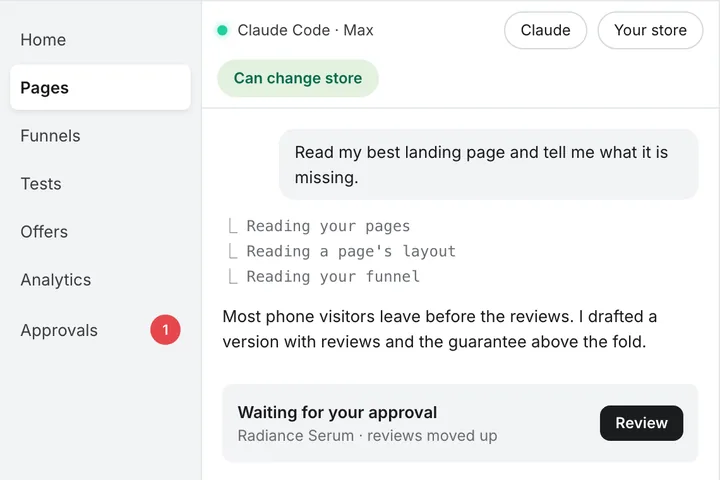
In GemBoss, the answer is simple: the operator does the work, and you approve every launch and every winner. There is no mode in which it ships on its own, and it cannot give itself more authority.
This is what separates responsible automation from a black box. You can always see what it did, why, and what it wants to do next.
Where does the approval happen?
In the GemBoss dashboard.
Each experiment arrives with the full picture: traffic split, significance, the before-and-after, the reasoning. You approve or hold, and nothing ships until you do.
That approval gate is what makes "self-driving" practical for a small team. The optimization runs whether or not you are at your laptop, and the decision still routes through you. This is covered in more depth in why every change still needs your yes.
Self-driving CRO vs traditional CRO vs "automation"
These three are easy to blur, so here is the honest difference.
| Traditional CRO | Generic "AI automation" | Self-driving conversion optimization | |
|---|---|---|---|
| Who finds the idea | Human specialist | Human, usually | The system, from real behavior |
| Who builds the test | Designer + developer | You, with a tool | The system |
| Who reads the result | Analyst | Often nobody | The system, to significance |
| Who decides what ships | Human | The machine, unchecked | Human, at an approval gate |
| Runs continuously? | No, project by project | Sometimes | Yes, by design |
| Main risk | Slow and expensive | Off-brand or unsafe changes | Low, because a human approves |
Traditional CRO is rigorous but slow and costly. Generic automation is fast but risky because it removes the human. Self-driving conversion optimization keeps the rigor and the speed while keeping you in the loop. It is the middle path that most small brands actually need.
What does self-driving optimization actually test?
Anything that moves the conversion rate, prioritized by likely impact. Common experiments include:
- Product page layout: the order of image, price, reviews, and add-to-cart.
- Add-to-cart friction: a sticky button on mobile, a clearer CTA, a quick-view option.
- Trust and proof: where reviews, guarantees, and shipping info appear.
- Offers and upsells: whether a bundle or an upsell offer lifts average order value without hurting conversion.
- Speed: because a faster page converts better, and page weight is testable.
- Copy and headlines: the promise a shopper reads first.
Notice these map to the real reasons stores underperform. If you want the diagnostic version of this list, read why your AI-built store isn't converting.
Who needs self-driving conversion optimization?
You benefit most if any of these are true:
- You launched a store and have not meaningfully changed it since.
- You buy traffic (ads) but your conversion rate is average or worse, so you are paying for visitors you lose.
- You do not have a CRO specialist and cannot justify hiring one yet.
- You are the founder, the marketer, and the support team all at once, and testing keeps falling to the bottom of the list.
You may not need it yet if you have almost no traffic. Optimization needs visitors to learn from; with a trickle of sessions, tests take too long to matter. In that case, focus first on getting the store built well and driving traffic. A well-built AI store gives the optimization loop something real to work with once the visitors arrive.
How GemBoss builds this in
GemBoss is the AI conversion engine for Shopify: it builds headless funnels and storefronts on top of your store, tests them, and waits for your approval on every change. Most store builders stop at Compose: they help you launch and then leave. Operate is the part that keeps going.
The Operate layer runs the loop described above through GemBoss's own testing engine, with your approval built in before anything ships. It sits on top of your own Shopify, so your checkout, orders, and customer data stay exactly where they are. You own your data and your domain. There is no lock-in.
GemBoss is built by the team behind GemPages. What is new is that the store does not go quiet the day it launches. It keeps bringing you the next change to approve.
If you want to see the mechanics in your own store, tests and personalization is where the loop lives, and the pricing page shows what each plan includes.
Frequently asked questions
Is self-driving conversion optimization the same as A/B testing?
No. A/B testing is one tool inside it. Self-driving conversion optimization is the full continuous loop: finding opportunities, building the test, running it to significance, deciding, and shipping with approval. A/B testing is the measurement step; self-driving CRO is the system that keeps running that step for you, forever.
Will the AI change my store without asking?
No. In GemBoss, nothing reaches your shoppers until you approve it: not a test launch, and not a winning variant. The operator cannot raise its own permissions.
How much traffic do I need for this to work?
Enough for experiments to reach statistical significance in a reasonable time. Higher-traffic stores see winners faster. Very low-traffic stores should focus first on building well and driving visitors, then turn on optimization once there is real behavior to learn from.
Does it work with my existing Shopify store?
Yes. GemBoss sits on top of Shopify. Your checkout, orders, products, and customer data stay in Shopify, and you keep your domain. The optimization layer reads behavior and ships approved changes without moving your store off the platform you already run.
What does the operator do without me?
It watches behavior, writes hypotheses, builds variants, and measures tests while they run. Launching a test and shipping a winner both wait for your approval in the dashboard.
Ready to stop letting your store go stale after launch? See how the Operate layer keeps finding the next change, or start a 14-day free trial and approve your first test when you are ready.
See a store built on your brand
Bring a store you admire or describe your brand. GemBoss captures it, ships a brand-true storefront, and brings you the next change to approve after launch.
Request a demo →Want this every morning? GemNews puts a Shopify and AI briefing in every new tab, free.