





 Shop the gift


How can I run Shopify funnels outside the Liquid theme?
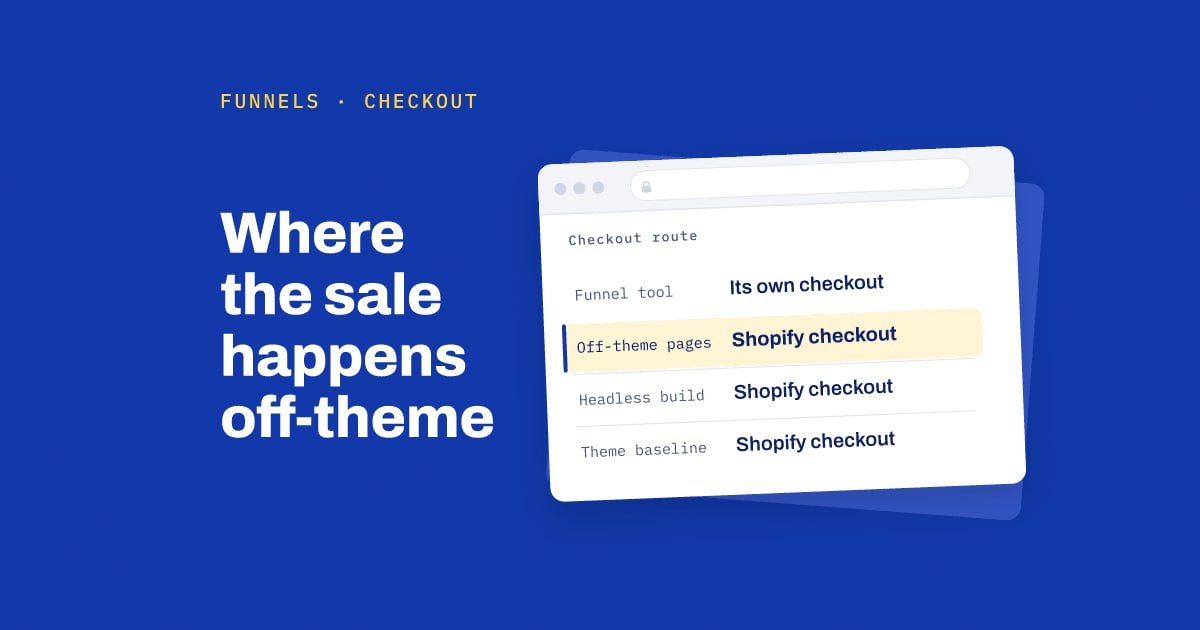
You can run Shopify funnels outside the Liquid theme four ways. On vendor pages read 26 Oct 2026, funnel tools keep their own checkout; the other three routes can hand the cart to Shopify checkout.
Quick answer
- Funnel tools such as ClickFunnels and Funnelish host the pages and take payment on their own checkout. Funnelish syncs orders to Shopify.
- Off-theme pages from Replo, or Shopify's own Buy Button, can send the cart to Shopify checkout, so Shopify creates the order.
- A custom Hydrogen build gives full control, and Shopify's docs say headless costs more to build and run than a theme.
- A headless funnel layer such as GemBoss serves only the funnel pages. Checkout stays on Shopify, and the theme keeps the rest of the store.
- Whichever route you pick, put it through the five questions of the off-theme hand-off check.
The fork that matters is checkout, because the checkout decides where the order is created.
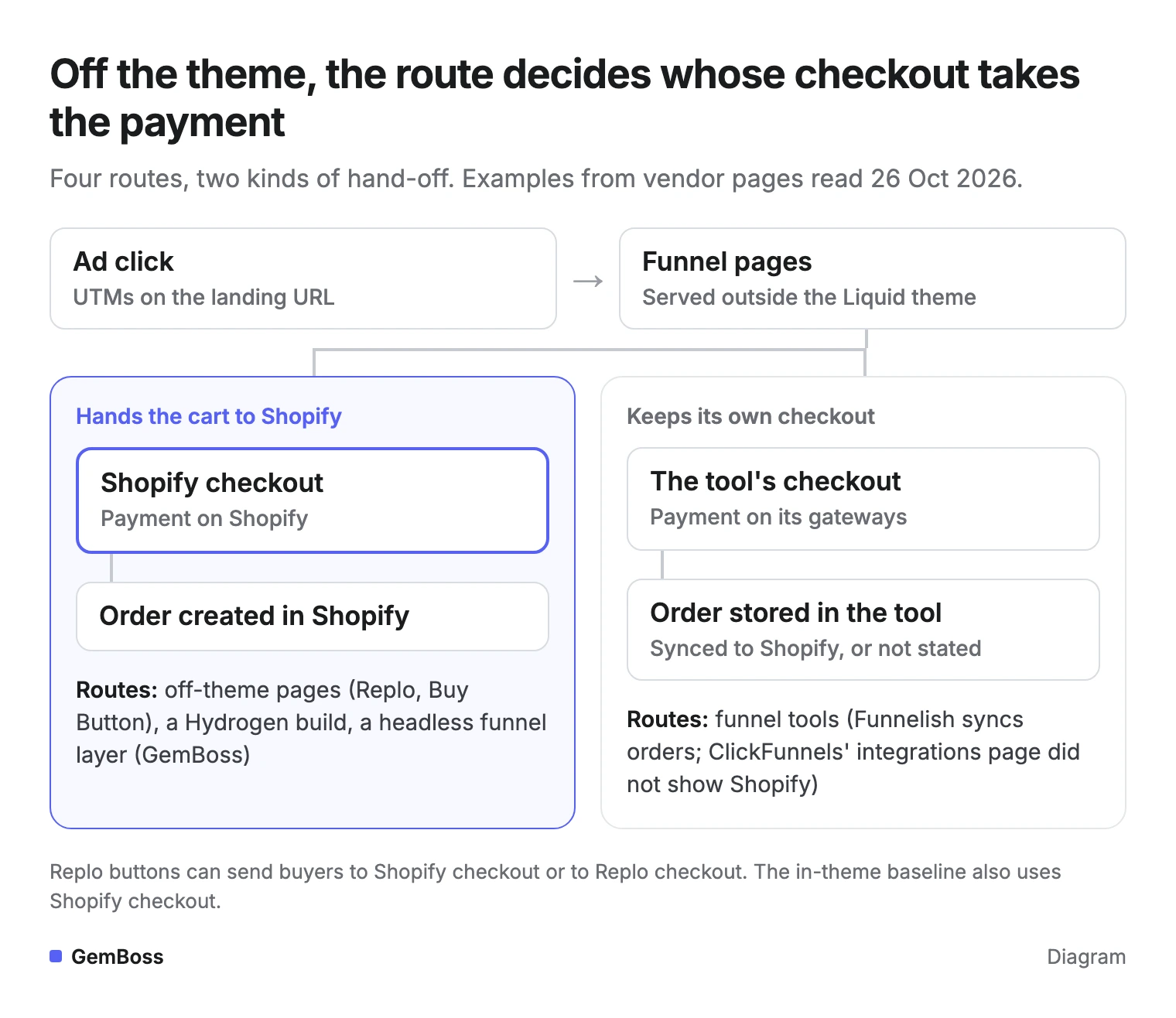
What does it mean to run a funnel outside the Liquid theme?
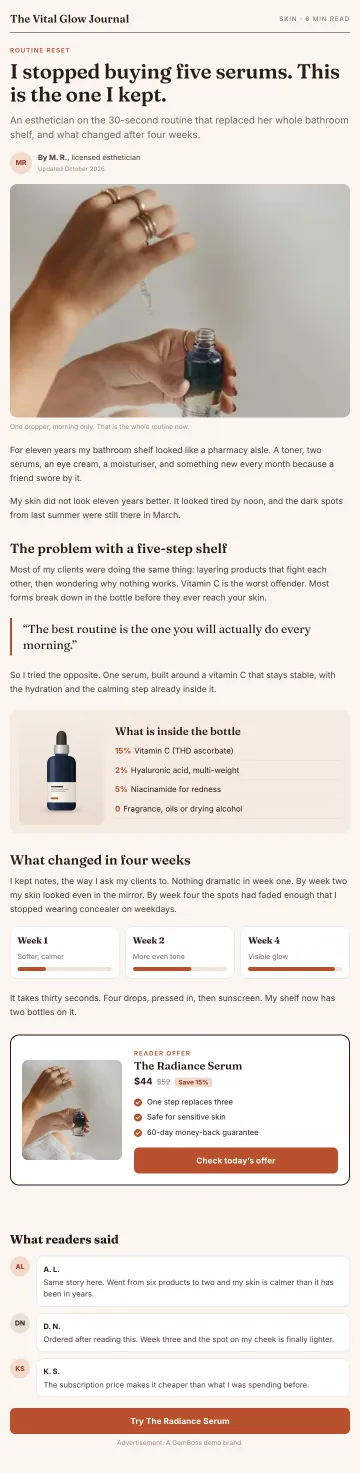
An off-theme funnel is a chain of ad landing pages that your theme doesn't render, with checkout and orders kept in Shopify or moved elsewhere. Liquid is Shopify's theme templating language, so pages built in the theme editor or an in-theme page app still count as in-theme. The chain usually starts with a pre-sell page, an article-style page that warms the reader up before the product page.
Shopify's developer docs call the general pattern headless commerce: you build the frontend, and Shopify's APIs handle the commerce underneath. Its page About headless commerce lists buy buttons on a site you already have as one option, next to Hydrogen and your own stack. Mixing is normal too, and Shopify's enterprise guide says Sennheiser runs headless storefronts alongside Shopify themes for smaller markets.
In Shopify's own table, the three marked rows run from a full custom build to buy buttons on a site you already run.
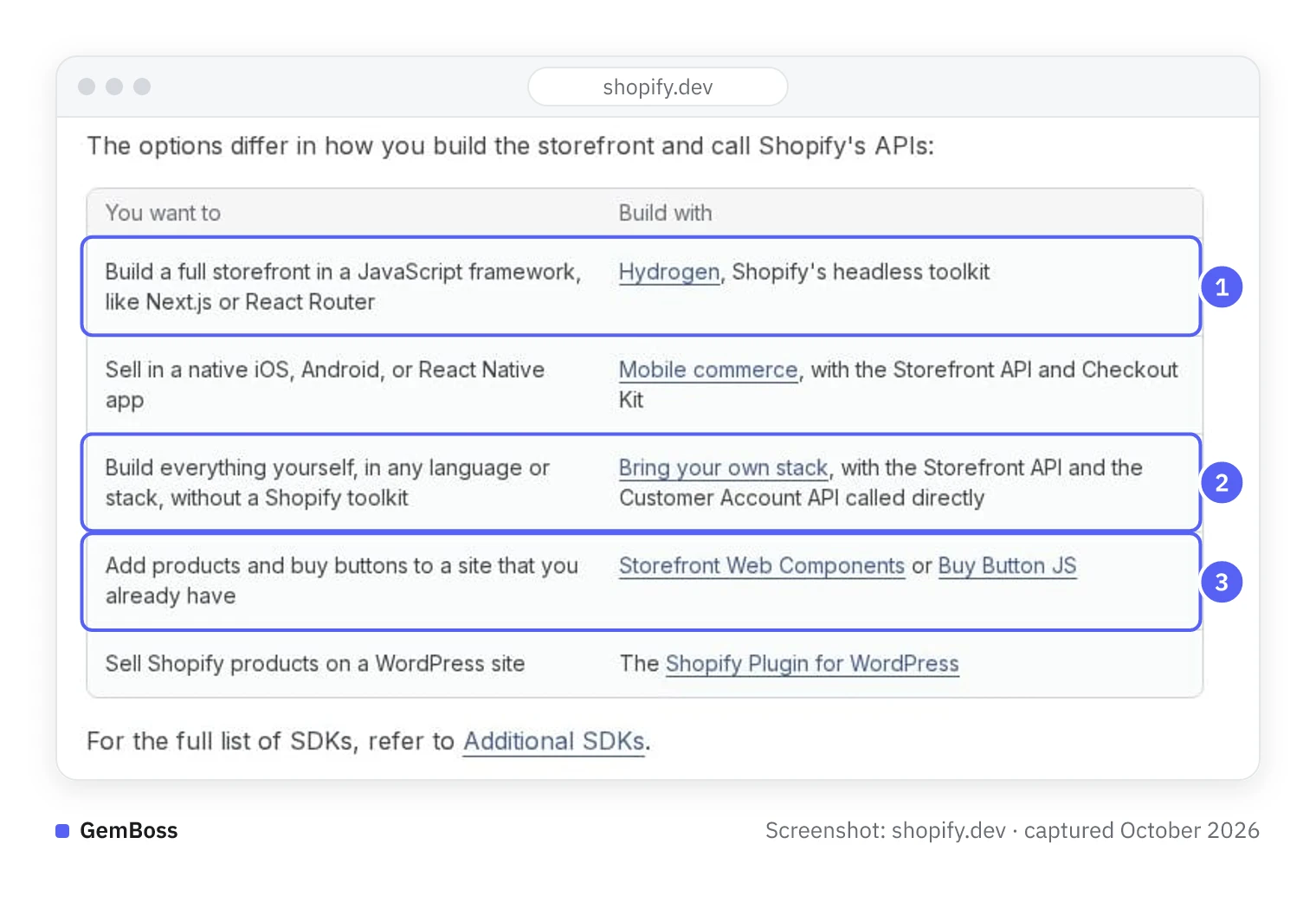
- Hydrogen, for a full storefront in a JavaScript framework: the custom headless build in the table below.
- Your own stack, calling the Storefront API directly: also a custom build.
- Buy buttons on a site you already have: the lightest way to sell outside the theme.
A funnel needs far less than a whole storefront, so the real question is what stays in Shopify.
How do I run Shopify funnels outside the Liquid theme?
Pick one of four routes, or keep the funnel in the theme as your baseline. The routes split first on where the sale happens, then on cost and who runs them. Prices are monthly list prices in US dollars unless noted, read on each vendor's page on 26 Oct 2026.
Where the sale happens
| Route | Checkout | How orders reach Shopify | Domain | Best for |
|---|---|---|---|---|
| In-theme baseline: your Liquid theme, or a page app such as GemPages (our sister product) | Shopify checkout | Created in Shopify | Your store's domain | Funnels your theme and apps already handle |
| Funnel tool: ClickFunnels | Its own checkout pages (Smart Checkout) | Not stated; Shopify is not among the integrations it lists | Free ClickFunnels subdomain; 5 custom domains on Launch, unlimited above | Funnels, email and courses in one tool, with unlimited visitors |
| Funnel tool: Funnelish | Its own checkout, on gateways you connect (Stripe, PayPal, Airwallex, NMI) | Synced: Shopify orders synchronization on every plan | 1 custom domain on Basic, 5 on Pro, 50 on Advanced | Product checkouts with upsells and order bumps, 0% extra processing fees |
| Off-theme pages: Replo | Shopify checkout or Replo checkout | Created in Shopify when the button uses Shopify checkout; not stated for Replo checkout | Your own domain; 1 custom domain on Starter and on Pro | Ad landers built with an AI agent, with a free tier to try |
| Off-theme pages: Shopify Buy Button or Storefront Web Components | Shopify checkout | Created in Shopify | The site you already run | One product or collection on an existing site |
| Custom headless build: Hydrogen on Oxygen, or Next.js on Vercel | Shopify checkout; Hydrogen ships no checkout UI | Created in Shopify | Wherever you host it; Vercel Pro includes a free custom domain | Teams with developers who need a fully custom frontend |
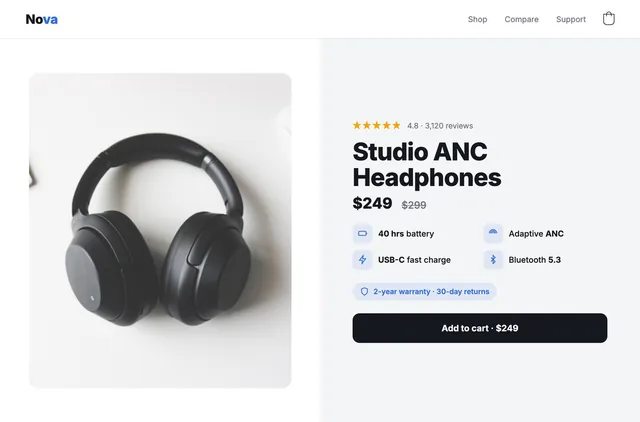
| Headless funnel layer: GemBoss | Shopify checkout on every plan | Orders stay in Shopify | Funnel URL format not stated on the gemboss.ai pages we read | Brands running paid ads that want each funnel step tested on revenue per session |
What it costs and who runs it
| Route | Traffic on the entry plan | Tracking | List price, read 26 Oct 2026 | Who builds |
|---|---|---|---|---|
| In-theme baseline | Not compared | Shopify pixels; the Customer Privacy API applies consent to pixels and checkout | Your Shopify plan; page apps priced separately | You or a developer, in the theme editor or a page app |
| ClickFunnels | Unlimited visitors on every plan | Built-in analytics and A/B testing | Launch $97, Scale $197, Optimize $297 a month; $81, $164, $248 a month billed annually; Dominate $5,997 a year | You, in the drag-and-drop ClickFunnels Editor |
| Funnelish | 20,000 visitors a month on Basic; 100,000 on Pro; unlimited on Advanced | Advanced funnel analytics; a Facebook events tracking app | Basic $49, Pro $99, Advanced $249 a month; yearly saves about 17% | You, in its funnel builder; Enterprise adds migration and design support |
| Replo | 100,000 visitor sessions a month on Starter; 500,000 on Pro | Revenue and conversion tracking; flexible attribution models | Starter $119, Pro $599 a month; $99 and $499 a month billed annually; free tier with 1,000 one-time credits | Replo's AI agent, edited by chat or click; Pro adds 10 hours of onboarding |
| Buy Button or Web Components | Not stated | Not stated on the pages we read | No separate price on the Buy Button page | You or a developer, pasting embed code |
| Hydrogen or Next.js | No fixed requests-per-minute limit for real buyers on the Storefront API; automated traffic and checkout creation have separate limits | First-party Shopify analytics with consent handling (Hydrogen) | Oxygen hosting free, plan eligibility not stated; Vercel Pro $20 a month with $20 of usage credit; developer time extra | Developers, who also maintain it after launch |
| GemBoss | 10,000 funnel sessions a month on Starter | UTM attribution by campaign, ad and angle; Meta Conversions API, with server-side events for Meta only | Starter $49, Growth $149, Scale $399 a month; Enterprise from $999; Managed from $690 | GemBoss drafts and a person approves; on Managed, an operator builds |
Every row assumes you keep paying for your Shopify plan, so that fee is left out. Traffic units differ between vendors: Funnelish counts visitors, Replo counts visitor sessions, and GemBoss counts funnel sessions. ClickFunnels lists unlimited visitors on every plan, and Funnelish lifts its cap on Advanced.
The off-theme hand-off check
The off-theme hand-off check is five questions to ask any vendor before funnel traffic leaves your theme. Each question maps to a column in the route table, and the numbers match the card.
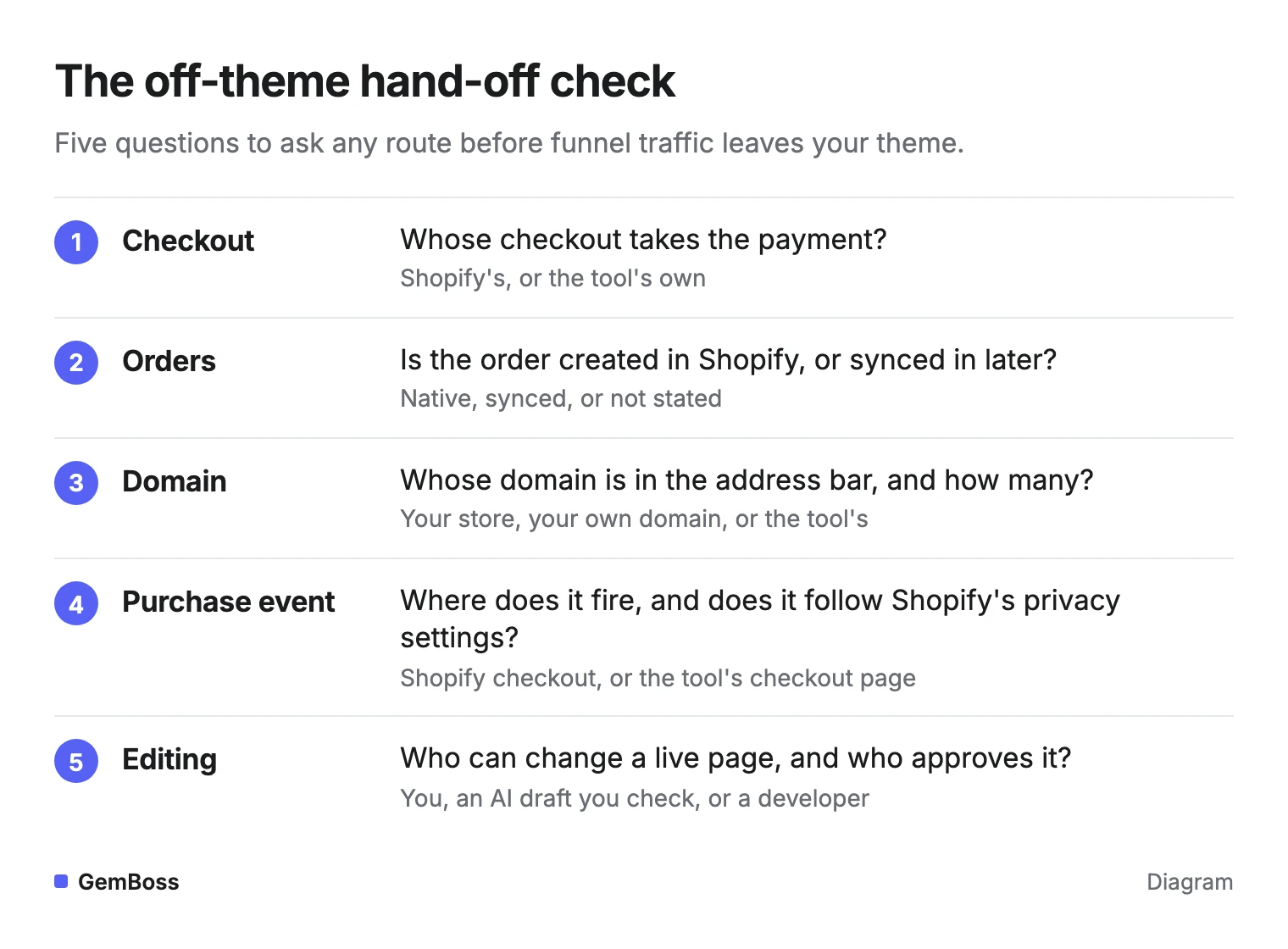
- Checkout: whose checkout takes the payment? ClickFunnels and Funnelish use their own. Buy Button, Hydrogen and GemBoss use Shopify's, and Replo can use either.
- Orders: is the order created in Shopify, or synced in later? A synced order reaches Shopify only while the sync runs, so ask the vendor what happens when it fails.
- Domain: whose domain sits in the address bar, and how many do you get? ClickFunnels' Launch plan includes 5 custom domains, while Funnelish Basic and Replo Starter include 1. A free subdomain on the tool's own domain, such as the one ClickFunnels gives you, works, but it puts the tool's name in the address bar.
- Purchase event: where does the purchase event fire, and does it follow Shopify's customer privacy settings? Shopify's Customer Privacy API applies consent decisions to Shopify-managed surfaces like pixels, audiences and checkout.
- Editing: who can change a live page, and does anything publish without a person's yes? Replo's homepage, for one, says you review the plan before big jobs run.
A route can fail one question and still suit you, if you accept that trade knowingly.
Does checkout stay on Shopify when funnel pages leave the theme?
Checkout stays on Shopify on every route except the funnel tools that bring their own. Shopify's Storefront API serves products, collections, search and the cart, then hands customers off to checkout, according to Shopify's developer docs.
The hand-off itself is one link.
The cart returns a checkoutUrl that redirects the customer through Shopify's web checkout, as Shopify's cart guide explains. Here is that path from an off-theme page to a Shopify order:
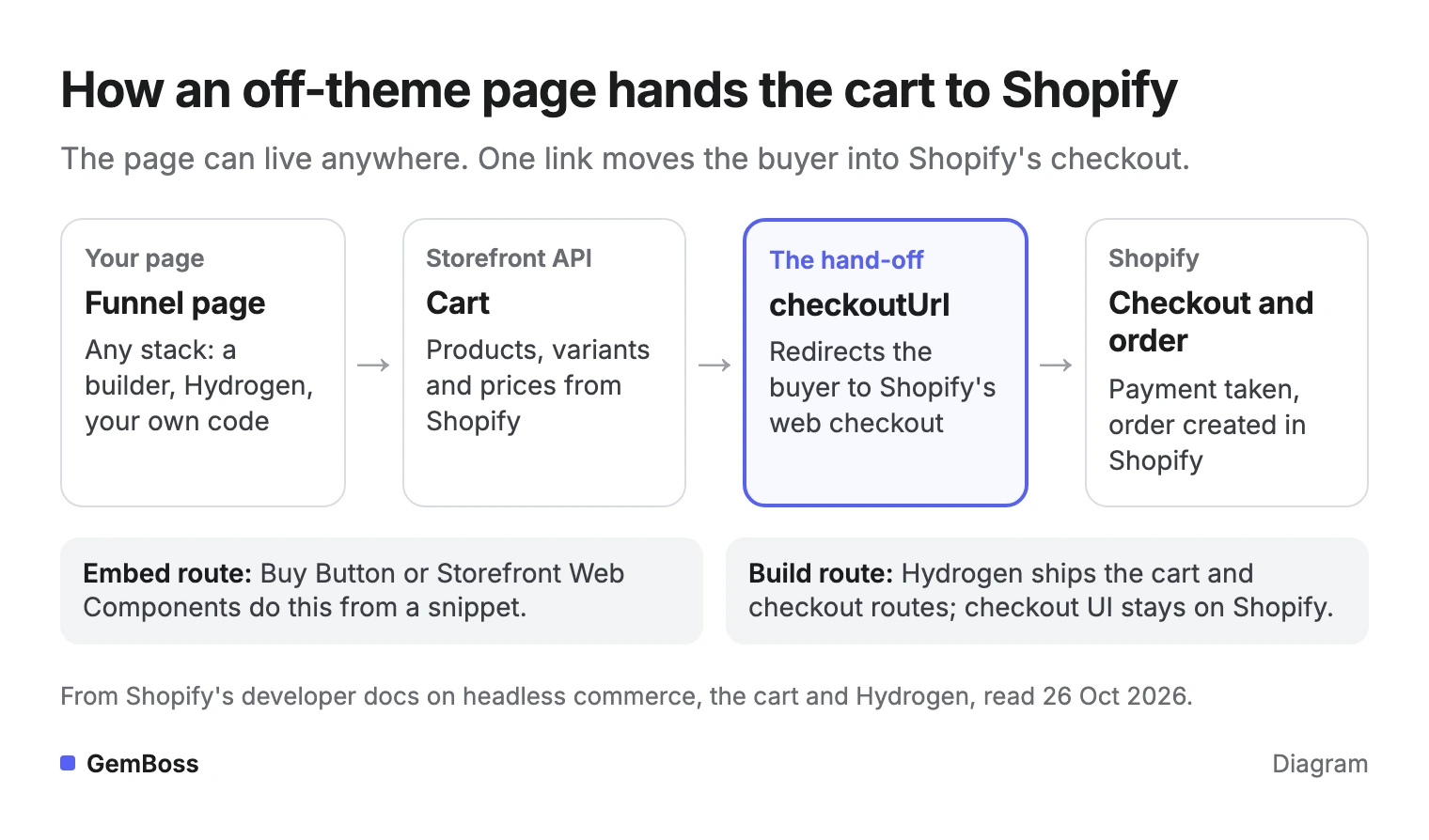
Hydrogen follows the same path. Its docs say Hydrogen ships no checkout UI because checkout stays on Shopify, which provides the Storefront API, the Customer Account API and checkout. Custom builds also inherit a URL chore: Shopify asks storefronts that change the /products/:handle format to redirect it, and to support cart permalinks.
Builders who go headless describe the split the same way.
andrew jennings says on X that they build almost every Shopify store headless now, for their own brands and for clients. His stack starts with “Shopify for checkout, subscriptions, catalog - it stays the commerce engine” (post).
When the funnel tool owns the checkout
Funnel tools move the payment instead. ClickFunnels sells its own checkout pages and a payments product called Payments AI, and its pricing FAQ says it takes no percentage of your sales. Funnelish sells product checkouts with order bumps on gateways you connect, such as Stripe and PayPal, with 0% extra processing fees.
Orders then reach Shopify only if something carries them there. Funnelish's pricing page lists Shopify orders synchronization on every plan. ClickFunnels' integrations page, read 26 Oct 2026, did not list Shopify among the tools it showed.
If fulfillment, subscriptions or reporting run in Shopify, that difference matters more than page design.
How do you keep tracking through to the order off the theme?
Tracking follows the payment, because the purchase event fires on the page where the buyer pays. On Shopify-checkout routes that page is Shopify's checkout, and on funnel tools it is the tool's checkout. Map each route's purchase event before you move an ad:
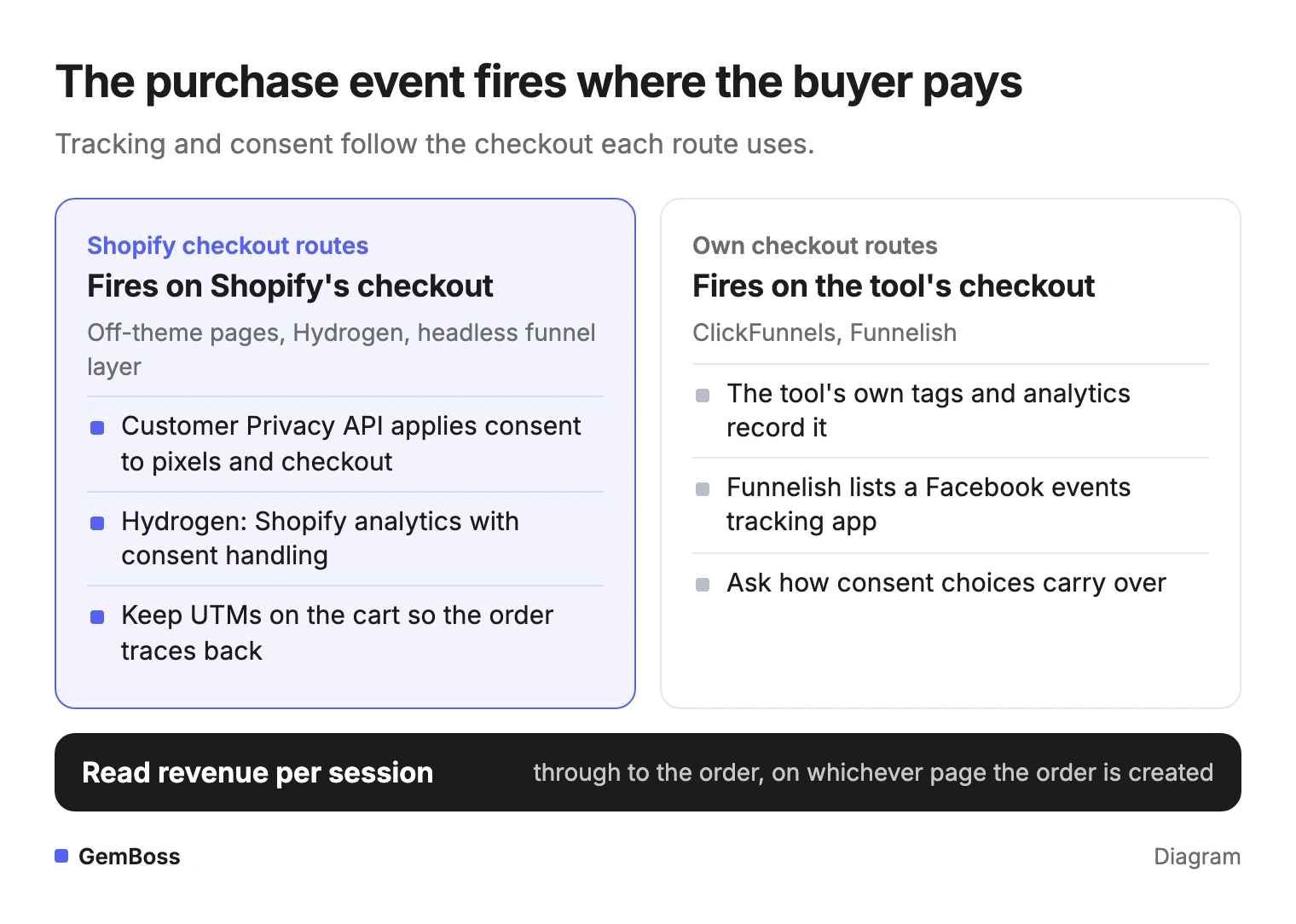
Privacy settings travel with that event.
Shopify's Customer Privacy API applies consent decisions to pixels, audiences and checkout. On a custom build, Hydrogen includes first-party Shopify analytics with consent handling.
On a funnel tool's checkout, the tool's own tags do the work. Funnelish, for example, lists a Facebook events tracking app on every plan, so ask each vendor how a shopper's consent choice reaches those tags.
Keep the ad's UTMs through to the order
Attribution needs one more link: the ad's UTM tags have to survive from the landing page to the order. Ask each vendor where it records them and whether its order report shows them by campaign.
Then read every test on revenue per session through to the order.
A page that lifts clicks but loses buyers shows up in that number. The playbook on how to test one funnel step at a time covers the setup without a data team.
What do the routes cost, and who builds them?
List prices are only part of the cost, because someone also has to build the pages and keep them working. Shopify's headless docs say it plainly: “A headless storefront costs more to build and run than a theme”. The same page asks whether the merchant has developers to maintain the storefront after launch.
Paid entry plans for funnel tools and builders, billed monthly, ran from $49 to $119.
For a custom build, Shopify's Hydrogen site offers free hosting on Oxygen, and Vercel's Pro plan costs $20 a month with $20 of usage credit. Neither covers developer time, and no vendor page we read priced it. The bill for a whole headless store is a separate question, covered in what a full headless build costs.
Who edits the pages
Price aside, routes also differ in who can change a page once it is live. Who edits shifts from you, to an AI draft you check, to developers:
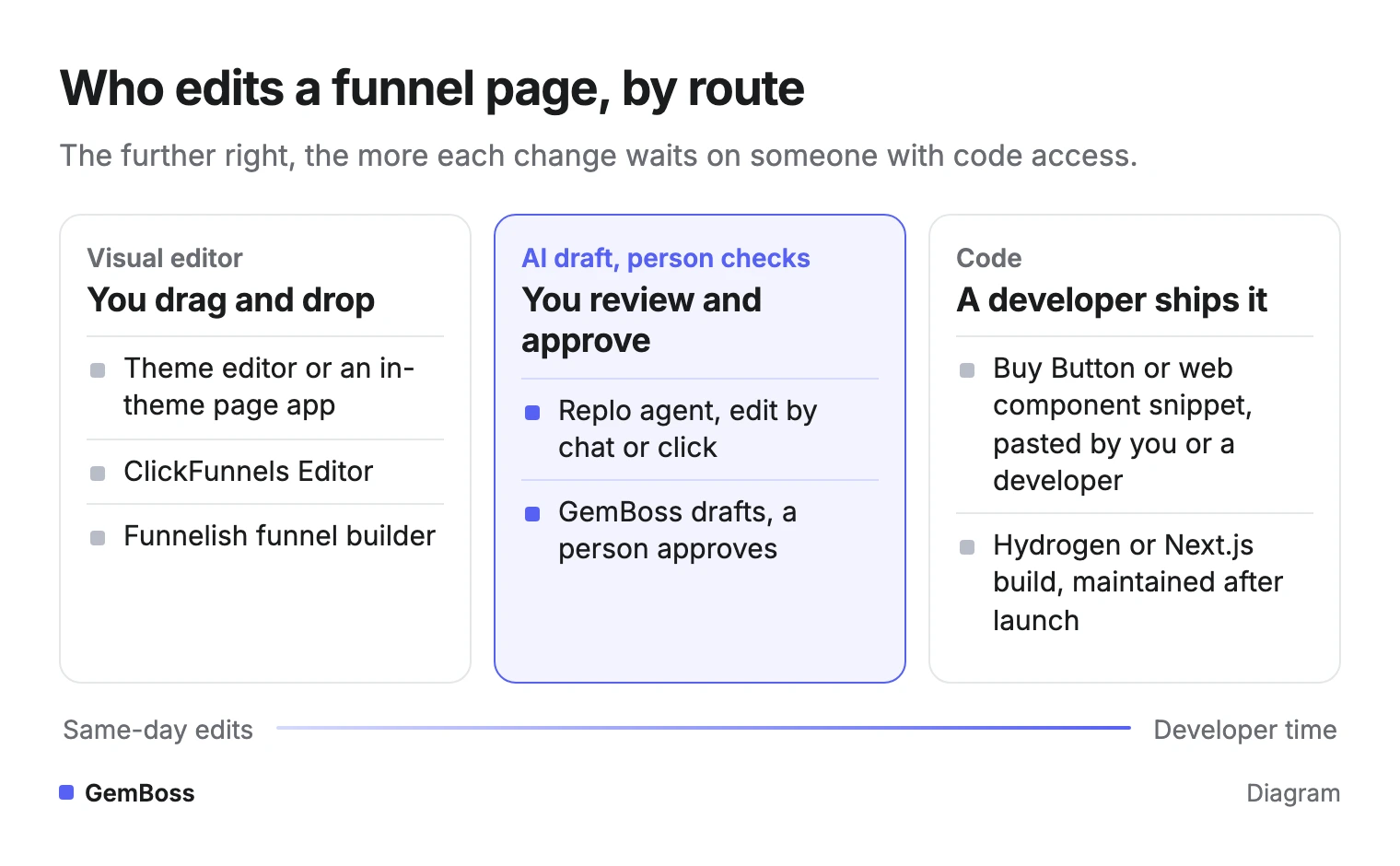
That column matters as much as price. A page your team can change the same day lets you fix a losing landing page quickly. A page that needs a developer waits for one.
When is a better theme enough?
A better theme is enough when your theme and apps already do what the funnel needs. Shopify's guide to headless commerce says to keep a themed storefront then, and when slow pages come from fixable images, apps or theme code.
Some builders have moved back.
Ben Paine wrote on X: “Im not sure headless shopify is the way to go anymore. Making an exceptional theme was the move for Graphite TFA.” (post)
When leaving the theme pays
Inside the theme, page apps such as GemPages (GemPages is our sister product) build pages and sales funnels in Liquid. Speed belongs in the decision too, so check how page speed shows up in conversion before you blame the theme.
Leaving the theme starts to pay when the funnel outgrows what the theme does well.
In practice, that means many ad-specific pages live at once, each changed without touching the store theme. For the whole-store version of this choice, read headless vs Liquid for the whole store.
Which route fits your team?
Three answers, taken in order, narrow the routes to one or two. Start with the theme, then checkout, then who will maintain the pages:
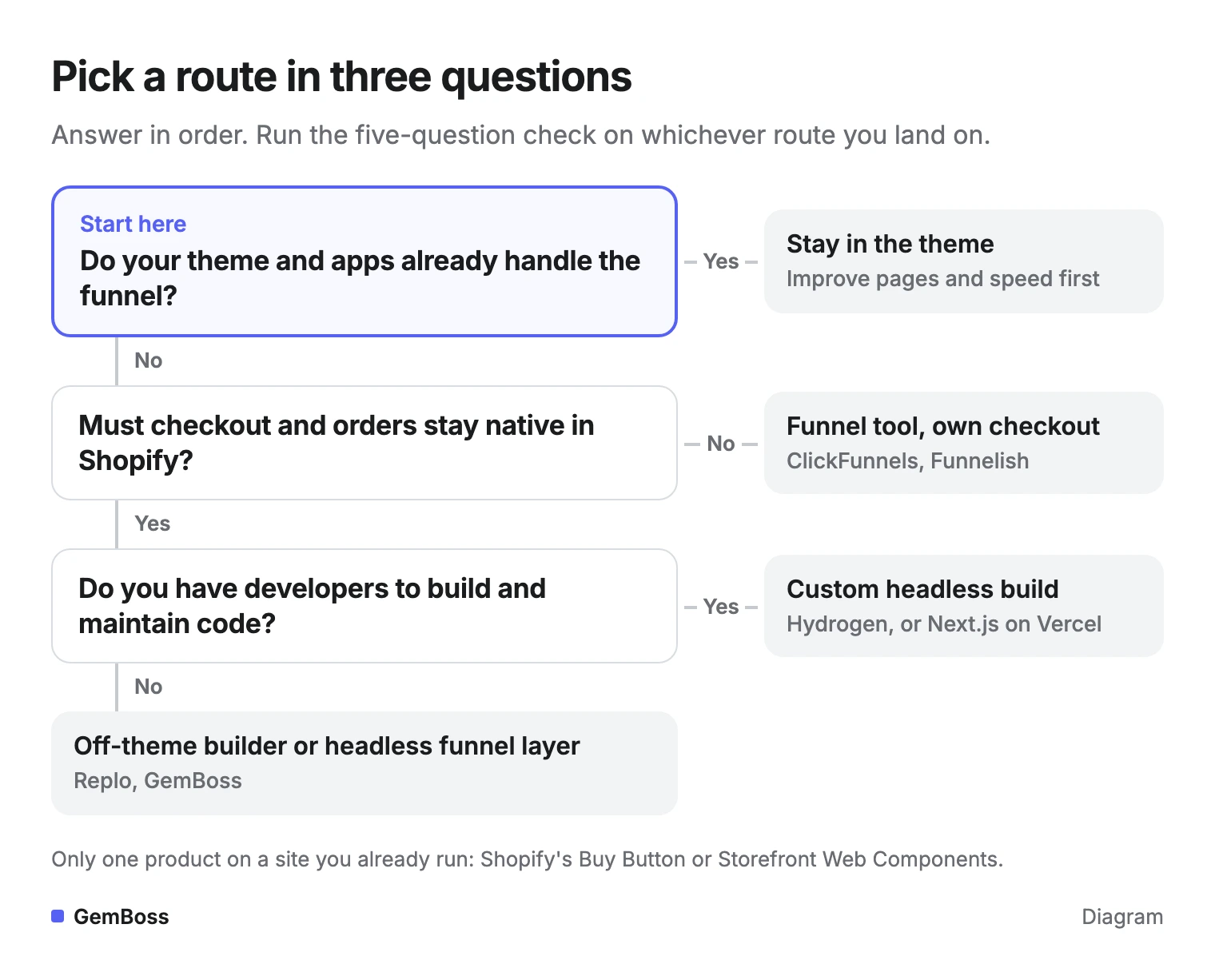
- If your theme and apps already handle the funnel, stay in the theme and fix pages and speed first.
- If orders can live in another tool, or arrive by sync, a funnel tool with its own checkout fits. Funnelish syncs orders to Shopify; ClickFunnels' integrations page did not show Shopify on 26 Oct 2026.
- If checkout and orders must stay native and you have developers, a Hydrogen or Next.js build gives full control.
- If checkout must stay native and nobody on the team writes code, use an off-theme builder such as Replo or a headless funnel layer.
- If you only need one product on a site you already run, Shopify's Buy Button is the smallest step.
Whichever branch you land on, run the hand-off check before you move ad spend.
How we checked
We read each vendor's own pricing or product page on 26 Oct 2026 and copied plan names, limits and list prices as shown. Prices are monthly billing in US dollars unless the table says annual or yearly. Replo's pricing page loads on annual billing, so we switched its toggle to monthly to read $119 and $599.
Where a page did not say something, the table says not stated.
ClickFunnels URLs we tried for a Shopify integration page returned 404, and Shopify's Help Center returned 403, so Oxygen's plan eligibility is left out. Shopify's pricing page showed Singapore dollars to our reader, so Shopify plan fees are not compared. No price or plan detail comes from a third-party review or roundup.
What the top-ranking pages cover
We also counted what the nine pages in Google's top 10 for this question name, on 26 Oct 2026:
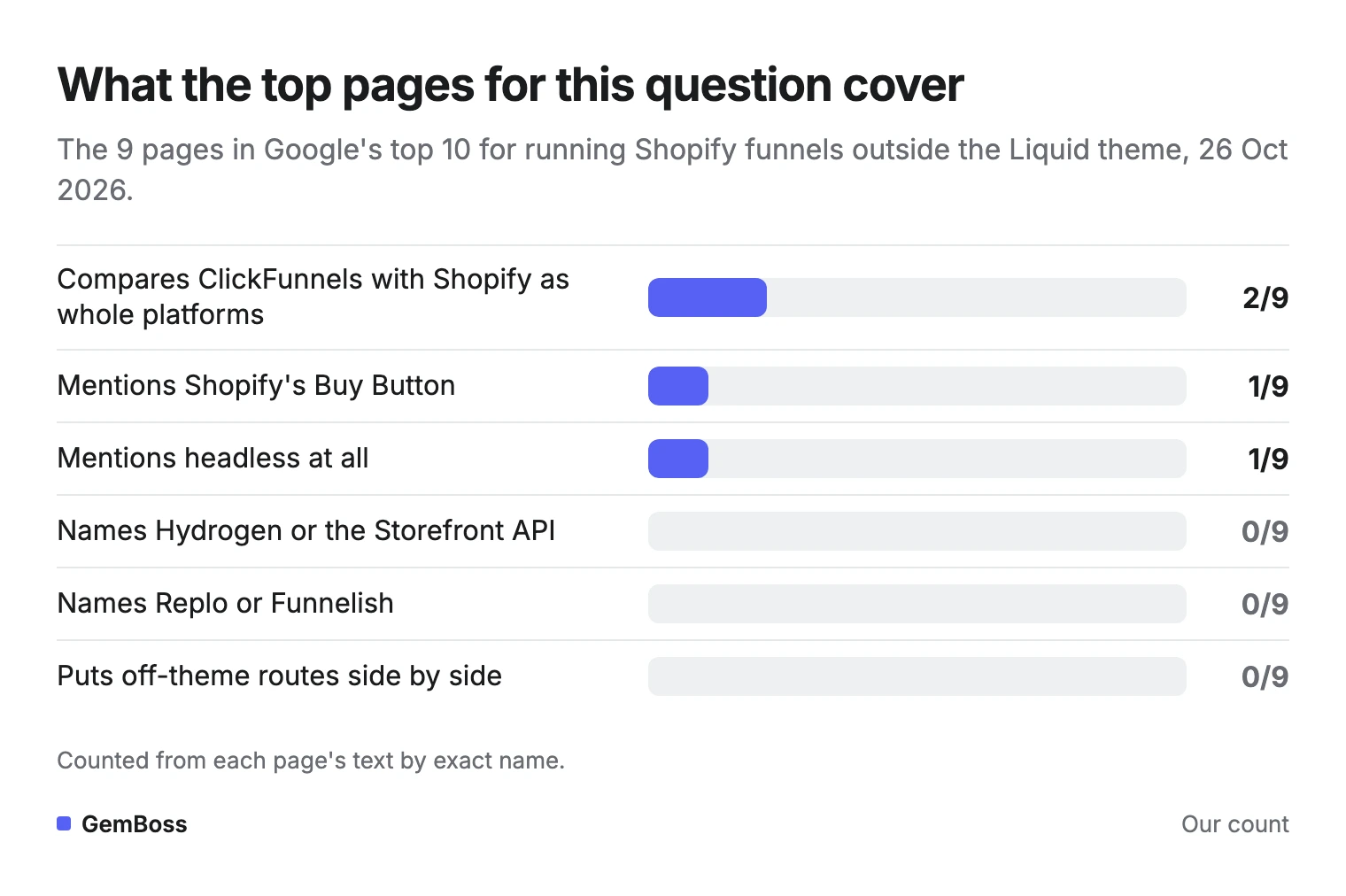
Two compare ClickFunnels with Shopify as whole platforms. None names Hydrogen, Replo or Funnelish, and none puts the off-theme routes side by side.
How GemBoss handles this
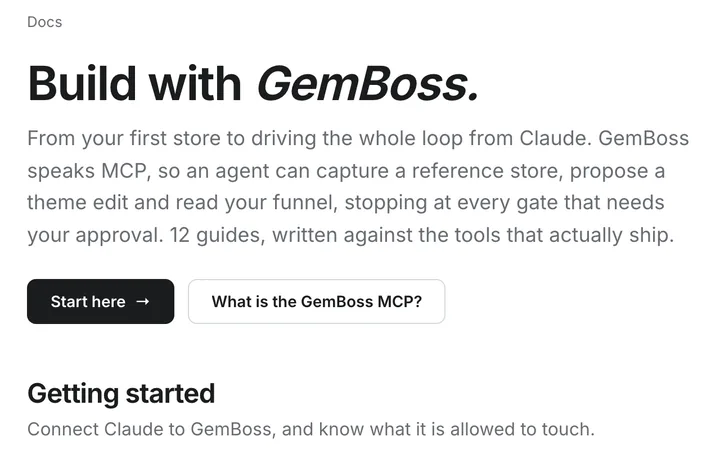
GemBoss is the headless funnel layer in the table, sitting on top of your existing Shopify store. Catalog, checkout, orders and apps stay in Shopify. Moving the whole store is an optional storefront add-on.
Per the pricing FAQ, funnels run on their own pages and your theme serves the rest.
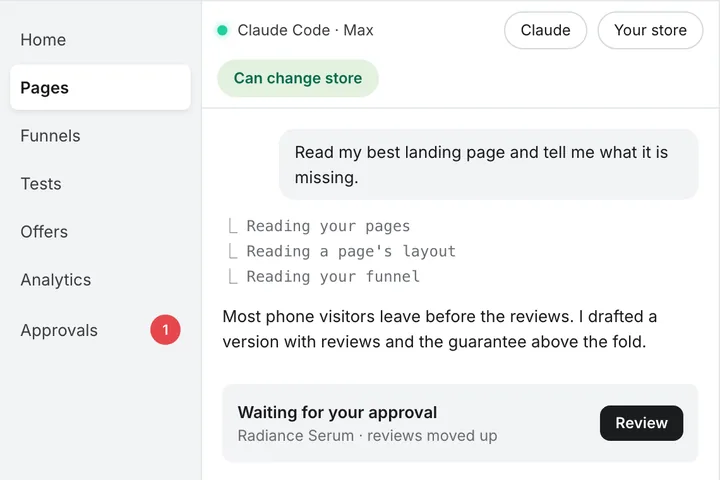
The funnel builder builds the path from the pre-sell page to the step after checkout, and you can test any step. A person promotes the winner, judged on revenue per session through to the order.
Tracking, approvals and price
The engine attributes orders by campaign, ad and angle from UTMs, and sends purchases back to Meta through the Conversions API. Server-side events go to Meta only, while TikTok, Google and Microsoft get a browser tag and UTM attribution. Shoppers who opt out through Shopify's customer privacy settings are not tracked, per the enterprise page.
GemBoss does not create or run your ad campaigns, and nothing publishes on its own. Plans start at $49 a month for 10,000 funnel sessions, with a 14-day free trial on self-serve plans. Managed, where an operator builds the funnels, starts at $690 a month. If your theme already handles the funnel, or you need server-side events for TikTok or Google, GemBoss is not the right pick. Its server-side events go to Meta only.
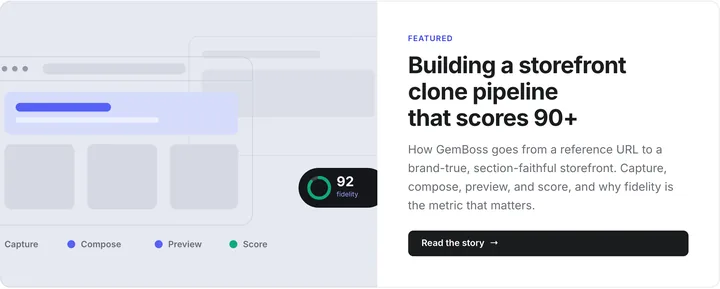
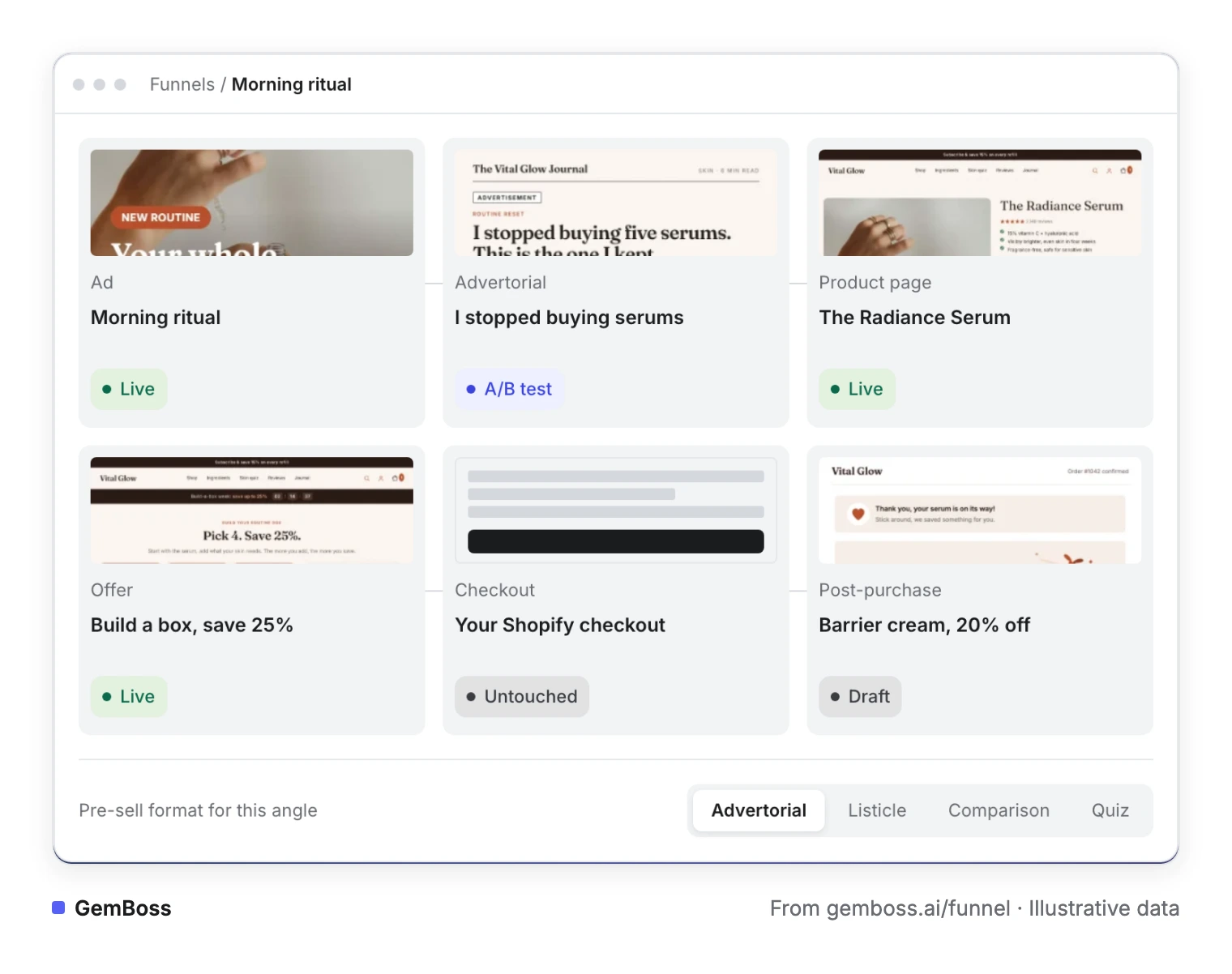
The funnel board on gemboss.ai leaves the checkout step as Shopify's own:
Frequently asked questions
Which funnel builders work outside the Shopify theme, and what does each cost?
ClickFunnels and Funnelish run funnels on their own checkout, from $97 and $49 a month on pages read 26 Oct 2026. Replo builds off-theme pages from $119 a month ($99 billed annually), and GemBoss runs headless funnel pages from $49 with checkout on Shopify. A Hydrogen build can host free on Oxygen but needs developers.
Can I use Shopify as a landing page?
Yes: build a landing page inside your theme with the theme editor or a page app, and checkout stays native. For a page on another site, Shopify's Buy Button embeds a product card and checkout. Shopify's docs also offer Storefront Web Components for adding products and buy buttons to an existing site.
Can ClickFunnels work with Shopify, or do I have to pick one?
You can run both, but on ClickFunnels' own checkout the sale happens in ClickFunnels. Its checkout pages and payments are its own, and its integrations page did not list Shopify on 26 Oct 2026. If Shopify handles your fulfillment or subscriptions, ask ClickFunnels how orders would reach Shopify before you send traffic.
Is headless Shopify worth it?
It is worth it when the theme blocks something the funnel needs and someone can maintain the result. Shopify's docs say a headless storefront costs more to build and run than a theme and needs developers after launch. For funnel pages alone, an off-theme builder or a headless funnel layer avoids rebuilding the whole store.
Does a headless funnel replace my Shopify theme?
No. A headless funnel layer serves only the funnel pages, while your theme keeps serving the rest of the store and checkout stays on Shopify. Shopify's enterprise guide says retailers can use a mix of headless and traditional storefronts.
How much does Shopify headless cost?
There is no single price, but hosting can be small: Shopify's Hydrogen site offers free Oxygen hosting, and Vercel Pro is $20 a month. Developer time comes on top, and no vendor page we read priced it. For more build options, see other ways to build a headless storefront.
Sources
- About headless commerce · Shopify developer docs, read 2026-10-26
- Hydrogen (version 2026-10) · Shopify developer docs, read 2026-10-26
- Manage a cart with the Storefront API · Shopify developer docs, read 2026-10-26
- Customer Privacy API · Shopify developer docs, read 2026-10-26
- Hydrogen: Shopify commerce in your framework · Shopify, read 2026-10-26
- Headless commerce: definition, benefits and costs · Shopify Enterprise blog, 2026-04-28
- Buy Button · Shopify, read 2026-10-26
- Plans and pricing · ClickFunnels, read 2026-10-26
- Integrations · ClickFunnels, read 2026-10-26
- Pricing · Funnelish, read 2026-10-26
- Pricing, monthly and annual billing · Replo, read 2026-10-26
- Homepage · Replo, read 2026-10-26
- Pricing · Vercel, read 2026-10-26
- Post on a headless Shopify stack · andrew jennings on X, 2026-09-11
- Post on headless versus a theme · Ben Paine on X, 2026-09-01
- Pricing, funnel builder, engine and enterprise · GemBoss, read 2026-10-26
- Screenshot of Shopify's developer docs, captured October 2026 · Shopify
A store you own, run for you
See GemBoss build on your brand. Open framework, your data, no lock-in, and keep optimizing it every week.
Request a demo →Want this every morning? GemNews puts a Shopify and AI briefing in every new tab, free.